There is a widening gulf between leadership and governance in Nigeria, a gulf that explains, more than anything else, the country’s stalled development despite its immense human and natural resources. While many nations across the world are deliberately building systems that advance civilisation, strengthen security, and invest heavily in human capital, Nigeria continues to grapple with a pattern of leadership that too often prioritizes personal enrichment over national progress.
Globally, governance has evolved into a forward-looking enterprise. Countries are not merely reacting to present challenges; they are proactively designing policies to secure the future. Investments in education, healthcare, infrastructure, and technological innovation are not accidental—they are strategic. Governments are planning for generations yet unborn, building resilient institutions capable of withstanding economic shocks, external aggression, and even unforeseen natural disasters. This is what responsible leadership looks like: a commitment to continuity, stability, and collective advancement.
In stark contrast, Nigeria’s experience tells a troubling story. Successive administrations have frequently been dogged by allegations and, in some cases, proven instances of corruption, mismanagement, and capital flight. Public resources that should serve as the backbone of national development are instead diverted, often finding their way into private accounts both within and outside the country. This pattern has not only weakened institutions but has also eroded public trust and stifled economic growth.
The consequences are visible everywhere. Critical infrastructure remains underdeveloped, security challenges persist, and social services struggle to meet the needs of a growing population. Rather than deliberate, long-term planning, governance often appears reactive, fragmented, and driven by short-term political interests. The absence of sustained investment in human capital— education, skills, and healthcare, means that Nigeria risks falling further behind in an increasingly competitive global landscape.
What is perhaps most concerning is the mindset underpinning this governance gap. In many advanced and emerging economies, leadership is anchored on stewardship, the understanding that public office is a trust to be managed for the benefit of all. In Nigeria, however, politics is too often seen as an avenue for wealth accumulation, where access to power translates into access to resources. This “primitive accumulation,” as some analysts describe it, undermines the very essence of governance.
Yet, this trajectory is not inevitable. Nigeria possesses the intellectual capacity, youthful population, and economic potential to chart a different course. What is required is a fundamental shift in leadership philosophy, from exploitation to service, from short-term gain to long-term nation-building. Institutions must be strengthened, accountability enforced, and transparency made non-negotiable.
Ultimately, the missing link is not a lack of resources or ideas, but a deficit of purposeful leadership. Until governance in Nigeria is reoriented toward the advancement of civilisation, the protection of its people, and the development of its human capital, the country will continue to lag behind peers who have chosen a more visionary path.
The future of Nigeria depends not just on who leads, but on how leadership itself is defined and practiced.
Tag:
Education
Zamfara Visit: UN Deputy Chief Reaffirms Strong Support for Development in Northwest
by Editor
written by Editor
By Chibuike Nwabuko
GUSAU (PRECISE POST) — The United Nations has reiterated its commitment to tackling pressing development challenges in Nigeria’s northwest region, as Deputy Secretary-General Amina Mohammed paid a strategic visit to Zamfara State.
During her visit to Gusau, the state capital, Mohammed held high-level talks with Governor Dauda Lawal and other key government officials, focusing on strengthening collaboration between the UN and local authorities.
According to the statement released on the official X account of United Nations Nigeria on saturday, the meeting underscored a shared determination to confront critical issues affecting the state and the broader northwest zone.
Speaking during the engagement, the UN Deputy Chief emphasized the organization’s readiness to support Zamfara in key sectors vital to sustainable development. These include improving access to quality education, strengthening healthcare systems, boosting agricultural productivity, promoting gender equality, addressing climate-related challenges, and enhancing the responsible development of solid mineral resources.
Zamfara, like much of northwest Nigeria, continues to face complex socio-economic challenges. Mohammed’s visit signals renewed international attention and a coordinated effort to accelerate progress in the region.
Officials present at the meeting welcomed the UN’s continued partnership, noting that such collaboration is essential for driving long-term growth, stability, and resilience. The discussions also explored practical pathways for implementing impactful programs that directly benefit communities.
Precise Post recalls that the visit marks another step in deepening cooperation between Nigeria and the United Nations, with a clear focus on delivering tangible improvements in the lives of people across Zamfara State and beyond.
FCT poll: Gwagwalada PDP candidate promises women empowerment, improved healthcare
written by Administrator
ABUJA – The Peoples Democratic Party (PDP) chairmanship candidate for Gwagwalada Area Council election, Kasim Mohammed, has called on women in the area to vote for empowerment, improved healthcare and better education for their children.
Mohammed made the call while addressing women groups and party supporters in Giri community, ahead of the FCT area council election scheduled for Feb. 21.
He described the forthcoming election as crucial to securing a brighter future for families.
“This election is not just about politics, but about choosing a leadership that prioritises the welfare of women, children and the entire community,” he said.
Mohammed urged the women and party supporters to vote for peace, progress and the overall development of Gwagwalada area council.
He also called for support for PDP to ensure improved water supply, better electricity, quality education and a stronger road network, adding that the election was a clear choice between progress and stagnation.
The chairmanship candidate encouraged residents to unite behind PDP to achieve sustainable development across the area.
In a related development, the chairmanship candidate also attended a joint meeting of Gbari, Gbagyi, Yoruba, Igbo, Hausa and Fulani women in Gwako, where PDP leaders rallied support ahead of the election.
Similarly, a former Chairman of the area council, Adamu Danze, popularly known as Obama, urged the youth to rise to their responsibility in shaping a better future for the district.
Danze reminded the youth of the historical significance of Nigeria and the FCT, stressing that Gwagwalada was their ancestral home and should not be traded for short-term gains.
Also addressing the gathering, the PDP Chairman in Gwagwalada, Umar Yunus, assured the youth that unity and vigilance would help in protecting their mandate.
Yunus welcomed some defectors into PDP and pledged that the party would provide a government that would serve all residents without discrimination.
Reports that the PDP chairmanship candidate also visited Wuna and Katse, among other communities. (NAN)
2026 Budget: Education, Health Get Boost as Tinubu Prioritises Human Capital
by Editor
written by Editor
By Chibuike Nwabuko
ABUJA (PRECISE POST) – PRECISE POST can authoritatively report that human capital development features prominently in the 2026 budget, with ₦3.52 trillion allocated to education and ₦2.48 trillion to health.
President Bola Tinubu said no nation can grow beyond the quality of its people, stressing that education and healthcare are central to economic transformation.
President Tinubu who made the declaration on Friday when presenting the 2026 budget to the jointh session of the 10th National Assembly, also revealed that over 418,000 students have already benefited from the Nigerian Education Loan Fund in partnership with 229 tertiary institutions.
In the health sector, the President highlighted new international support, including over $500 million in grant funding secured through engagements with the United States.
Healthcare spending, he noted, represents six per cent of the total budget size net of liabilities, with assurances that funds will be deployed transparently and effectively.
The Federal Government, in collaboration with the European Union (EU), has inaugurated a National Programme Steering Committee to oversee the €40 million Education and Youth Empowerment in Northwest Nigeria (EYEPINN) project.
The programme, which targets Jigawa, Kano, and Sokoto States, aims to reduce the number of out-of-school children, strengthen teacher capacity, and promote youth skill development in the region.
The committee — chaired by the Minister of Education, Dr. Tunji Alausa, and co-chaired by the Minister of Budget and Economic Planning, Senator Atiku Bagudu — will meet annually to provide policy direction, while a secretariat managed by the EU Technical Assistance Team will handle daily coordination. Quarterly technical meetings will also be held to monitor implementation progress.
Speaking at the inauguration in Abuja, the Permanent Secretary, Federal Ministry of Education, Abel Enitan, commended the EU for its continuous support and investment in Nigeria’s education sector, noting that the partnership has contributed significantly to improving access, equity, quality, and system resilience.
Represented by the Director of Polytechnic Education and Allied Institutions, Dr. Usman Ejeh, Enitan said:
“The EYEPINN project is a strategic intervention designed to tackle pressing challenges such as out-of-school children, inadequate teacher capacity, unsafe learning environments, and limited youth empowerment opportunities in the Northwest region.”
He added that the committee would ensure accountability and alignment of project outcomes with national education policies.
“Every Euro invested must translate into tangible impact — improved learning outcomes, better-trained teachers, safer schools, and a more resilient education system that leaves no child behind,” he emphasized.
The EU Delegation’s Team Leader for Human Development, Leila Ben Amor Mathieu, described the initiative as the EU’s first standalone education project in Nigeria.
“We designed this programme closely with the Nigerian Ministry of Education to address the real needs of the people,” she said.
She further noted that the EU had committed about €800 million to national programmes between 2021 and 2027, excluding regional initiatives that also benefit Nigeria.
Mathieu explained that the EYEPINN project, implemented through UNICEF, Plan International, DIME, and other technical partners, focuses primarily on basic education, especially for out-of-school and nomadic children.
“We’re confident that this project will start delivering measurable results soon, with the World Bank also assessing its impact,” she added.
UNICEF’s Chief of Education, Vanessa Lee, said the project aligns with Nigeria’s education reform efforts.
“This programme comes at a critical time to support both federal and state education agencies in transforming the system,” she said.
UNICEF, she added, remains committed to reducing the number of out-of-school children through digital learning, data-driven planning, and enhanced teacher training initiatives.
Similarly, the Country Director of Plan International, Dr. Charles Usie, praised the EU’s continued support across various development sectors, describing the initiative as “a source of hope for children who might otherwise be left behind.”
Country Director of Save the Children International, Duncan Harvey, also emphasized the importance of the programme.
“Every child — regardless of background, gender, or ability — deserves access to quality education,” he said.
The Northwest region currently faces one of Nigeria’s worst education crises, with millions of children out of school due to insecurity, poverty, and inadequate infrastructure. According to recent estimates, Nigeria has about 20 million out-of-school children, with the Northwest accounting for a large portion of that figure.
Mathematics No Longer Compulsory for Arts Students in Tertiary Admissions — FG
written by Joy: News Admin
The Federal Government has announced that senior secondary school students in the Arts and Humanities will no longer be required to present a credit in Mathematics in their Senior School Certificate Examination (SSCE) — conducted by the West African Examinations Council (WAEC) and the National Examinations Council (NECO) — as a prerequisite for admission into universities and polytechnics.
For years, all admission seekers, regardless of discipline, were required to secure five credits, including English Language and Mathematics, to qualify for entry into higher institutions.
However, under the newly revised National Guidelines for Entry Requirements into Nigerian Tertiary Institutions, the Ministry of Education has reviewed this policy to remove barriers while maintaining academic standards.
According to a statement issued on Tuesday by the ministry’s spokesperson, Folasade Boriowo, the new framework applies to universities, polytechnics, colleges of education, and Innovation Enterprise Academies nationwide. The revised entry criteria are as follows:
Universities: A minimum of five (5) credit passes in relevant subjects, including English Language, obtained in not more than two sittings. Mathematics remains compulsory only for Science, Technology, and Social Science courses.
Polytechnics (ND Level): A minimum of four (4) credit passes in relevant subjects, including English Language for non-science programs and Mathematics for science-related ones.
Polytechnics (HND Level): A minimum of five (5) credit passes in relevant subjects, including English Language and Mathematics.
Colleges of Education (NCE Level): A minimum of four (4) credit passes in relevant subjects, with English Language mandatory for Arts and Social Science courses, and Mathematics required for Science, Vocational, and Technical programs.
Education analyst Ayodamola Oluwatoyin, speaking in Abuja, praised the development as a step in the right direction, noting that it would make tertiary education more accessible.
“This is a brilliant reform that will open doors and ease the process of gaining admission for many qualified students who were previously hindered by Mathematics requirements,” Oluwatoyin said.
The Minister of Education, Dr. Tunji Alausa, described the reform as part of the government’s deliberate efforts to expand access to higher education and promote inclusivity.
He revealed that the ministry has also approved a comprehensive overhaul of admission entry requirements across all tertiary institutions in the country — a move expected to increase annual admissions from about 700,000 to one million students.
“Every year, over two million candidates sit for the Unified Tertiary Matriculation Examination (UTME), yet only about 700,000 gain admission. This imbalance is not due to lack of merit but outdated and overly rigid entry requirements,” Alausa said.
He added that the reform aligns with President Bola Tinubu’s Renewed Hope Agenda, ensuring fairness and expanded opportunities for Nigerian youths.
“This reform is a deliberate effort to open up tertiary education for an additional 250,000 to 300,000 students annually. It reflects our commitment to ensuring every young Nigerian has a fair chance to learn, grow, and succeed,” he concluded.
The revised National Guidelines for Entry Requirements into Nigerian Tertiary Institutions mark one of the most significant education policy shifts in decades, aimed at breaking long-standing barriers to learning while upholding academic integrity.
The Federal Government has directed all vice-chancellors of federal universities to immediately implement the “No Work, No Pay” policy against members of the Academic Staff Union of Universities (ASUU) who are participating in the ongoing nationwide strike.
According to Naija News, the directive was issued through a circular dated October 13, 2025, signed by the Minister of Education, Dr. Tunji Alausa.
The circular was copied to the Head of the Civil Service of the Federation, the Permanent Secretary of the Ministry of Education, Pro-Chancellors of federal universities, the Director-General of the Budget Office, the Accountant-GeAneral of the Federation, and the Executive Secretary of the National Universities Commission (NUC).
The ministry expressed concern over reports of continued industrial action by ASUU despite several government efforts to foster dialogue.
“In line with the provisions of the Labour Laws of the Federation, the Federal Government reiterates its position on enforcing the ‘No Work, No Pay’ policy for any employee who fails to discharge his or her official duties during a strike,”
the circular stated.
Dr. Alausa instructed vice-chancellors to conduct a physical headcount and roll call of all academic staff, and to submit a detailed report identifying those present and working as well as those absent or participating in the strike.
He further directed that salaries of staff who fail to perform their duties during the strike period be withheld.
However, the minister clarified that members of the Congress of University Academics (CONUA) and the National Association of Medical and Dental Academics (NAMDA), who are not part of the industrial action, should be exempted from the policy.
The NUC was also mandated to monitor compliance across universities and submit a consolidated report to the ministry within seven days.
“Please treat this matter with utmost urgency and a deep sense of responsibility in the national interest,”
Alausa emphasized.
ASUU had on Sunday declared a total and comprehensive warning strike beginning Monday, October 13.
The union’s demands include:
Conclusion of the renegotiated 2009 FGN–ASUU Agreement
Release of withheld three-and-a-half months’ salaries
Sustainable funding and revitalization of public universities
An end to what it described as victimization of lecturers at LASU, Prince Abubakar Audu University, and FUTO
Payment of outstanding 25–35% salary arrears and over four years’ promotion arrears
Release of withheld third-party deductions such as cooperative contributions and union check-off dues
The latest directive marks a renewed government stance to ensure accountability and compliance within Nigeria’s university system amid escalating tensions between ASUU and the Federal Government.
The full list of subjects in the newly introduced school curriculum has surfaced online after the Special Assistant to the President on Social Media, Dada Olusegun, shared it on Wednesday.
Olusegun, in a post on his X handle, displayed an unsigned and unmarked image said to contain the subjects for Junior Secondary School and Senior Secondary School.
“The new curriculum for Nigerian Schools which will commence from the next session in September 2025 has been released,” he said.
The curriculum, which was unveiled by the Federal Government on Sunday, introduces compulsory digital literacy and basic entrepreneurship at the JSS level, while programming, artificial intelligence, and new languages feature prominently at the SSS level.
Below is the full list of subjects for JSS and SSS as shared:
JUNIOR SECONDARY (JSS 1–3)
- Mathematics & Measurement: Numbers, fractions, decimals, percentages, ratios, proportions, rates, geometry (angles, area, volume), algebra, statistics, graphs, measurement (km, m, cm, g, kg, ml, °C, time zones).
- English Language: Essay writing (narrative, descriptive), advanced grammar (clauses, idioms), comprehension, vocabulary, oral (debates, speeches, drama).
- Integrated Science: Physics (motion, forces, energy), chemistry (matter, mixtures, reactions), biology (cells, reproduction, ecology), earth science (climate, resources), technology, lab safety.
- Digital Literacy & Coding: Word, Excel, PowerPoint, internet research, coding (Python basics, Scratch advanced), robotics (basic kits).
- Social Studies: Nigerian and African history, geography, civics, economy (trade, money, entrepreneurship basics), global issues.
- Languages: Advanced mother tongue, conversational fluency in foreign language (French/Arabic).
- Creative Arts: Drawing, painting, crafts, drama, theatre, film basics, music.
- Physical & Health Education: Sports, fitness, nutrition, reproductive health, first aid, drug abuse awareness.
SENIOR SECONDARY (SS 1–3)
- Mathematics & Advanced Applications: Algebra, trigonometry, calculus basics, probability, statistics, financial maths, applied maths.
- English & Communication: Advanced essays, academic writing, literary analysis, world literature, research skills, public speaking, journalism, fact-checking.
- Sciences: Physics (mechanics, waves, electricity, nuclear physics), chemistry (organic, inorganic, industrial, analytical), biology (genetics, ecology, biotechnology), environmental science.
- Technology & Innovation: Programming (Python, JavaScript, HTML/CSS), data science basics, AI & robotics, digital entrepreneurship, cybersecurity.
- Social Sciences: Government & law, economics (micro, macro, trade), history (Africa, world revolutions), philosophy & ethics, entrepreneurship.
- Languages: Advanced mother tongue literature, fluency in international language (French/Arabic/Chinese optional).
- Creative Arts & Innovation: Fine arts, music, drama, film/media production.
- Physical & Health Education: Advanced sports, mental health, first aid & CPR, leadership.
- Research & Project Work: Final-year project, data collection, analysis, presentation & defense.
Why Govts Must Prioritize Investment in Health, Education and Poverty Alleviation – Peter Obi
by Edit
written by Edit
By Chibuike Nwabuko
ABUJA (PRECISE POST) – The Labour Party presidential candidate in the 2023 general election, Peter Obi has highlighted that the situation we find ourselves in Nigeria today calls for urgent and deliberate action by government in all levels to prioritize critical areas of development—particularly investment in health, education, and poverty alleviation.
Peter Obi, who expressed understanding of the plights of the people when he took to his X account on Tuesday, stressed that we must reassess what truly matters. The decisions we make—what we build, fund, and focus on—must align with the pressing needs of the people.
“Just this month, the World Bank reported that, as of April 2025, the poverty rate among rural Nigerians has risen to over 75%, indicating widespread economic hardship across the country. The report also highlighted that 41.3% of Nigeria’s urban population now lives below the poverty line. This shows that poverty is no longer just a rural crisis—it has become a national emergency.”
“In comparison, the World Bank reported that in 2018/2019, about 30.9% of Nigerians lived below the international extreme poverty line, the former Governor of Anambra State said.”
“As of 2025, that figure has more than doubled instead of improving.”
“These facts confirm that poverty in Nigeria has worsened significantly—and this is no coincidence.”
According to Obi, the situation we find ourselves in today is the direct result of years of misplaced priorities. Rather than investing in critical sectors, we have continued to prioritize wasteful spending on non-developmental projects such as conference centres, government houses and lodges, guest houses, and fleets of official vehicles—instead of investing in human capital, education, and healthcare, which are the true legacy projects capable of transforming a nation.
He advised that we must urgently redirect our national focus and address the root causes of poverty.
Adding that Nigeria must expand access to quality education and healthcare, and support job creation by investing in and empowering Micro, Small, and Medium Enterprises (MSMEs), which are essential for lifting people out of poverty.
US Tariffs: Speaker Abbas Proposes China Option, Seeks Stronger Ties With Asian Giant
by Edit
written by Edit
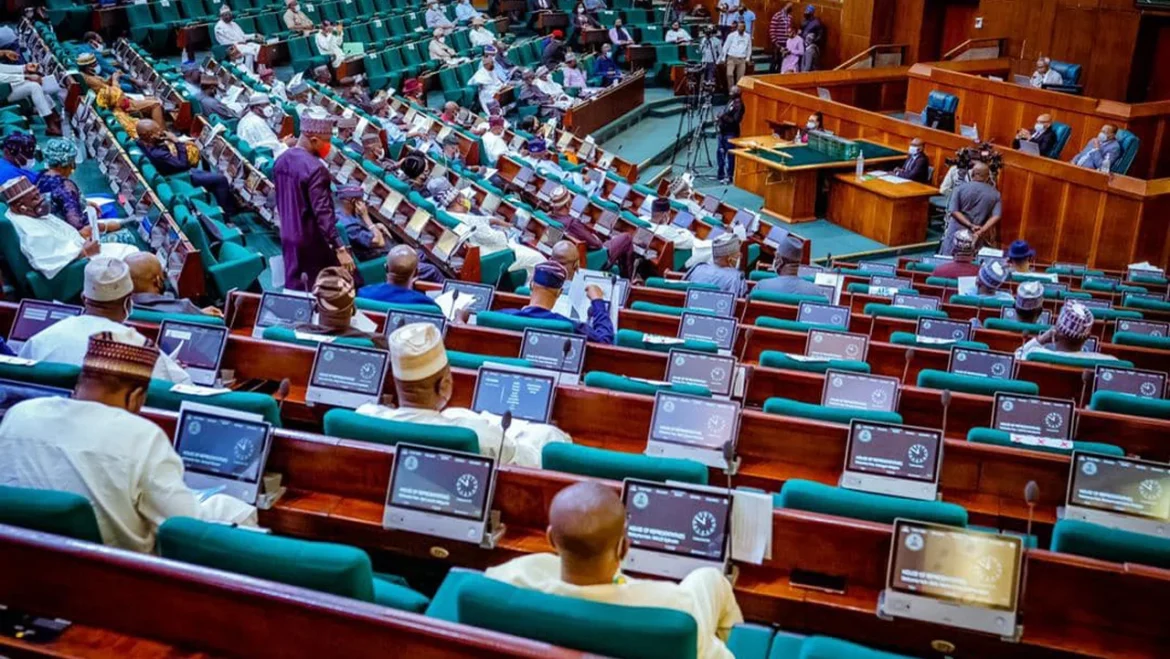
The Speaker of the House of Representatives Rt. Hon. Abbas Tajudeen, PhD., GCON, has called for a stronger bilateral relationship between Nigeria and China, as the United States imposes higher tariffs on foreign commodities.
Speaker Abbas, while addressing a delegation from the China People’s Political Consultative Conference (CPPCC) at his office on Friday, cited the Belt and Road Initiative and the Forum on China-Africa Cooperation as viable options for Nigeria following the ongoing global trade war.
According to the statement signed by the Special Adviser on Media and Publicity to the Speaker, House of Representatives, Musa Abdullahi Krishi made available to Precise Post on Friday, the CPPCC delegation, led by the Vice-Chairman, Mr. Hu Chunhua, paid a courtesy call on the Speaker.
The Speaker said: “In the face of evolving global trade dynamics, exemplified by the recent imposition of tariffs by the United States that have affected our non-oil exports, it is imperative that we diversify our trade partnerships. Enhancing our economic ties with China presents significant opportunities for our nation.
“In this regard, Nigeria is equally enthusiastic about deepening cooperation through platforms such as the Belt and Road Initiative and the Forum on China-Africa Cooperation. These initiatives provide promising avenues for expanding trade, fostering investment, and promoting knowledge exchange.”

Speaker Abbas noted that as the world witnesses China’s remarkable economic transformation, “we find in its experience a model of inspiration, particularly in the areas of industrial policy, poverty reduction and technological innovation.”
The Speaker stated that the National Assembly is dedicated to building enduring institutional ties with key Chinese legislative bodies, including the China People’s Political Consultative Conference and the National People’s Congress. He said this collaboration will enable mutual learning on legislative reforms, effective constituency representation, and democratic innovation.
Speaker Abbas added that the results of China’s recent ‘Two Sessions’, with their focus on inclusive development, scientific advancement, and environmental sustainability, present substantial common ground for both nations.

The Speaker reaffirmed the resolve of the House to the “noble pursuit of parliamentary diplomacy.” While noting that the legislative endeavours of the parliament remains pivotal in supporting Nigeria’s foreign policy objectives, he said, “by further strengthening our cooperation with China, we are better positioned to attain our shared aspirations for modernisation, peace, and prosperity.”
Speaker Abbas stressed that the enduring and strategic partnership between Nigeria and the People’s Republic of China lies at the core of the countries’ international relations. He noted that their collaboration spans vital sectors such as infrastructure, trade, health, and education.
“The recent elevation of our relationship to a Comprehensive Strategic Partnership is clear evidence of the mutual trust and resolve cultivated by the interactions between President Bola Ahmed Tinubu and President Xi Jinping. Nigeria’s steadfast support for the ‘One China Principle’ reflects our deep-rooted belief in the principles of sovereignty and territorial integrity, and we remain devoted to dialogue and cooperation as the means to address complex global challenges,” he said.
Earlier, the Vice-Chairman of the CPPCC, Mr. Chunhua, recalled that President Bola Ahmed Tinubu, GCFR, visited China last September, where the host president and the visiting president announced strategic partnerships.
“China stands ready to work with Nigeria on the agreements signed by the two presidents and resolutions of the Beijing Conference,” Chunhua said, while expressing the commitment of his country to prioritising issues of common interests between China and Nigeria.
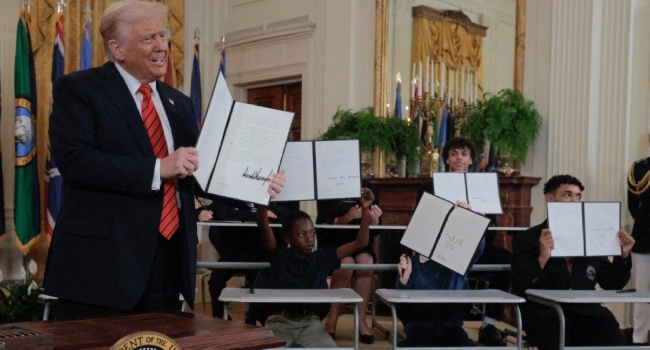
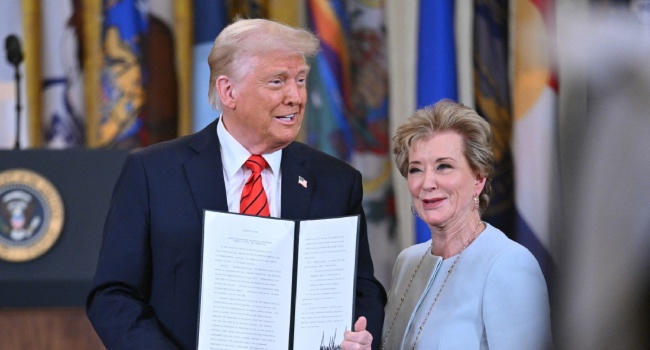
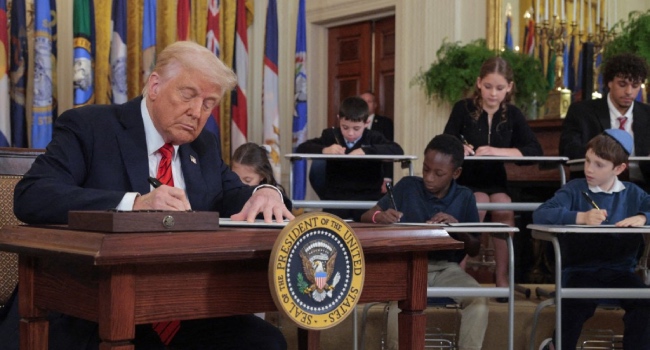
WASHINGTON – US President Donald Trump signed an order Thursday aimed at “eliminating” the Department of Education, a decades-old goal of the American right, which wants individual states to run schools free from the federal government.
Surrounded by schoolchildren sitting at desks set up in the East Room of the White House, Trump smiled as held up the order after signing it at a special ceremony.
Trump said the order would “begin eliminating the federal Department of Education once and for all.”
“We’re going to shut it down and shut it down as quickly as possible. It’s doing us no good,” Trump said. “We’re going to return education back to the states where it belongs.”

The Education Department, created in 1979, cannot be shuttered without the approval of Congress — but Trump’s order will likely have the power to starve it of funds and staff.
The move honors one of Trump’s campaign promises and is among the most drastic steps yet in the brutal overhaul of the government that Trump is carrying out with the help of tech tycoon Elon Musk.
The order directs Education Secretary Linda McMahon to “take all necessary steps to facilitate the closure of the Department of Education and return education authority to the States.”
Democrats and educators have slammed the move.
The top Democrat in the Senate, Chuck Schumer, called it a “tyrannical power grab” and “one of the most destructive and devastating steps Donald Trump has ever taken.”

Republican leaders, including governors Ron DeSantis of Florida and Greg Abbott of Texas, were in the audience for the signing ceremony.
Trump has cast the move as necessary to save money and improve educational standards in the United States, claiming they are lagging behind those in Europe and China.
But education has been a battleground for decades in America’s culture wars, and Republicans have long wanted to remove control of it from the federal government.
‘Beautiful day’
Trump’s appointment of McMahon — the former CEO of World Wrestling Entertainment — to lead the department was widely seen as a sign that its days were numbered.
The president said at the signing ceremony that “hopefully she will be our last secretary of education.”
McMahon, who moved to halve the department’s staff after being sworn in earlier this month, told reporters at the White House that Trump “wants to get those dollars back to the states without the bureaucracy of Washington.”

Trump promised on the campaign trail to get rid of the department and devolve its powers to US states, in much the same way that has happened with abortion rights.
But the White House said earlier that a rump education department was likely to stay on to deal with “critical functions” including loans and some grants for low-income students.
“The Department of Education will be much smaller than it is today,” Press Secretary Karoline Leavitt told reporters before the signing.
The Heritage Foundation — a right-wing think-tank that has seen many of its “Project 2025” recommendations adopted by Trump — welcomed the move.
“It’s a beautiful day to dismantle the Department of Education,” it said on X.
Traditionally the US government has had a limited role in education, with only about 13 percent of funding for primary and secondary schools coming from federal coffers, the rest being funded by states and local communities.

But federal funding is invaluable for low-income schools and students with special needs. And the federal government has been essential in enforcing key civil rights protections for students.
Trump, his billionaire advisor Musk and Musk’s Department for Government Efficiency (DOGE) have already dismantled several other government agencies, effectively crippling them by slashing programs and employees.
A similar move to dismantle the US Agency for International Development was halted earlier this week by a federal judge, who said the push likely violated the US Constitution.
AFP
…As Zaria constituents honour him for ‘service to humanity
By Chibuike Nwabuko
ABUJA (PRECISE POST) – The Speaker of the House of Representatives Rt. Hon. Abbas Tajudeen, Ph.D., GCON, has called for alternative sources of funds to finance education in Nigeria to reduce reliance on government resources.
The options, he said, include Public Private Partnerships (PPPs) and endowment funds, the statement released by his Special Adviser on Media and Publicity, Musa Abdullahi Krishi said.
Speaker Abbas made the call on Saturday at the 31st and 32nd Annual General Meeting of the Zaria Education Development Association (ZEDA) in Zaria, Kaduna State, where he was awarded in recognition of his “service to humanity.”
The Speaker, who was the Chairman of the combined AGM of ZEDA, urged the association to explore various opportunities.
“Diversifying funding streams is critical as well. By establishing endowment funds or engaging in public private partnerships, we can reduce our reliance on government funding. Successful models in countries such as Denmark and Ireland have demonstrated that diversified funding can drive long-term, sustainable growth in the education sector,” he said.
The Speaker stated that human capital development remains the cornerstone of our national progress. He cited the examples of Japan, Singapore, Switzerland, Taiwan, Luxembourg, Ireland, and Denmark, which have achieved remarkable progress.
“They have done so not by relying solely on natural resources but by investing heavily in education, training, and innovation. Their success is reflected in their high rankings on the Human Development Index and ease of doing business.
“Nigeria, blessed with vast natural resources, must equally prioritise the development of its people to realise its full potential,” he said.
Speaker Abbas said Zaria’s rich educational heritage, which dates back to the 16th century, continues to be a source of pride and inspiration.
As the home to Ahmadu Bello University and numerous other institutions, he noted that Zaria has contributed immeasurably to the intellectual and professional fabric of Nigeria.
While emphasising that “our shared heritage calls upon us to nurture this legacy for future generations,” the Speaker, who represents Zaria Federal Constituency, said several new educational initiatives, which he attracted to his constituency would go a long way to enhance learning in Kaduna State and beyond.
These projects include a Federal College of Education, a College of Health Sciences, a campus of the National Open University of Nigeria, and a College of Legal Studies.
“Once fully established, these institutions promise to extend significant educational and socio-economic benefits to our community,” Speaker Abbas stated.
The Speaker said that as Zaria celebrates these advances, it must not overlook the pressing challenges that impede educational progress. “We must address these challenges, especially in the realm of primary and secondary education,” he said.
While noting that the foundation of any thriving educational system rests upon robust, accessible, and quality basic education, Speaker Abbas said issues such as out-of-school children, those with special needs, and the overall quality of education demand urgent attention.
He said: “I commend the proactive measures by Governor Uba Sani’s administration in Kaduna State. The efforts have notably reduced the number of out-of-school children through the construction of over 62 new secondary schools, thereby addressing critical infrastructure deficits.
“Looking ahead, it is imperative that ZEDA continuously evolves to meet emerging challenges. Successful models, such as the United Kingdom Education Development Trust and Singapore’s Agency for Science, Technology and Research, have shown the benefits of embracing digital innovation.
“ZEDA should integrate technology in order to transform how we monitor educational outcomes, facilitate virtual training for teachers, and expand access to learning resources. By doing so, we can connect stakeholders, streamline processes, and enhance transparency.”
In the House of Representatives, the Speaker pointed out that the Legislative Agenda is aligned with these priorities. He said: “We remain committed to advancing universal basic education, enhancing secondary and technical education, and integrating innovative reforms that address both current and future challenges.”
Speaker Abbas hailed the Grand Patron of ZEDA , His Royal Highness, the Emir of Zazzau, Malam Ahmed Nuhu Bamalli, CFR, LLD, for his “fatherly guidance and unwavering commitment have been a beacon for ZEDA.”
Later, Emir Bamalli thanked the Speaker and other prominent indigenes of Zaria for their developmental strides in the ancient city. The monarch emphasised the importance of ZEDA to Zaria, while seeking more support from stakeholders.
By Chibuike Nwabuko
Port Harcourt – Rivers State Governor, Sim Fubara has said he would continue to consolidate on his achievements, and has vowed to prioritizing education, healthcare, security, general welfare of the people and upholding the integrity of our State in 2025.
Fubara stated this when he took to his X handle account on Thursday and said:
At the 2025 New Year State Banquet yesterday, we reflected on what was a challenging, yet transformative 2024 for Rivers State. Through resilience and God’s grace, we turned losses into gains.
In 2025, we will continue to build on these achievements, prioritizing education, healthcare, security, general welfare of the people and upholding the integrity of our State.
Your unwavering support remains the cornerstone of our success.
Wishing you a prosperous New Year!
At the 2025 New Year State Banquet yesterday, we reflected on what was a challenging, yet transformative 2024 for Rivers State. Through resilience and God's grace, we turned losses into gains.
— Siminalayi Fubara (@SimFubaraKSC) January 2, 2025
In 2025, we will continue to build on these achievements, prioritizing education,… pic.twitter.com/Y4tfhaP5Xk
ENUGU- The Presidential Candidate of Labour Party in 2023, Mr Peter Obi, says he donated over N200 million within a week for education in a bid to provide future for the younger generation.
Obi made this known during the 70th Anniversary of Queens School Enugu organised by Queens School Old Girls Association (QSEOGA), on Saturday.
“On Monday, I was in Onitsha where they started a new university. From there, I went to Borromeo College of Nursing.
“On Tuesday, I was at Anyigba in Kogi State to attend to students’ needs and on Thursdays, I was in Almajiri School in Kaduna to attend to their needs also.
“I have donated over N200 million within the week on education,” he said.
While emphasising the importance of investing in education, Obi said that no country would succeed without education.
He said that he was investing in the future of the young ones to discourage them from crime.
Obi, a former Governor of Anambra State, said that the future of any country would depend on its investment in health and education.
He decried the state of Queen School Enugu which, he said, had produced many great people but had lost its glory due to negligence.
“Those of you who studied in this school will be wondering how we got here.
“A school that has been celebrated has turned to nothing to be celebrated about.
“I am urging to you pull your resources together toward rebuilding this school.
“My appeal to old girls of this school and others in Nigerians is: Let’s go back and fix our schools than build new ones.”
He pledged to partner with the association to give a facelift to the school.
Earlier in her remarks, the National President of the association, Mrs Ifeanyi Egbunike, said that many things had gone wrong with the school.
She said that the school lacked new structures.
“I graduated from this school in 1974, and we are celebrating Queen School because it has come a long way. I am celebrating 50 year of being part of the school.
“The school has groomed and added value to many. We chose Obi because he was a man with vision, he is result-oriented and a lover of education,” Egbunike said.
The Chairperson of Enugu Chapter of the association, Mrs Maureen Atuonwu, said that Queen School Enugu was established in Oct. 4, 1954.
She said that alumni of the school came from all over the world to celebrate it at 70 years, adding that the association was working toward uplifting it.
“We have come together to discuss ways of rebuilding this school, as government alone cannot do it.
“We are partnering with Enugu State Government to see how we can take this school to greater heights.
“This school has produced a lot of professionals, who excelled in their various fields of endeavour, including Prof. Ngozi Okwonjo-Iweala,” Atuonwu said. (NAN)
Immediate past Governor of Abia State, Dr. Okezie Ikpeazu, who turns 60, today, spoke to Vanguard on how he will mark the day by empowering young men and women with business skills. He also expressed his belief in the Nigeria education system and disclosed how his father influenced his love for teaching.
How do you feel at 60?
I thank God that I’m strong and very healthy. I’m good,but I don’t feel 60 at all. Though I’m not celebrating, I’m marking my birthday by interacting with the common people. We have something that has been going on for some years now. This is the fourth season now where I dedicate my birthdays to interaction with startups; young men and women who are desirous of starting business.
I combine capacity building where I bring some resource persons to talk to them and perhaps expose them to sources of funding for new businesses whether through government grants or soft loans.
Other people will talk to them about registration and licensing for small businesses as well as basic book keeping on how you can differentiate between gross and net profits.
They will also be lectured on how you can plough back part of your income into the business and the imperatives of expansion .What do you think about in a futuristic manner to be able to take developments and happenings around your environment to leverage the growth of the business? How do you build resilience in a volatile economy? How do you create a buffer around your business for it not to collapse? This is because the business may collapse if you don’t take time as inflationary trends and health issues can consume your capital. Proper prioritization of expenditure and investments for small businesses are some of the key areas to be looked into during the lecture marking my birthday.
We will be talking to ordinary traders. I want to encourage people to imbibe the culture of taking what is replete in one place to another place where it is scarce. You can make money when you take sand from the beach where it is common to a place where building construction is happening. How do we leverage the spatial and differential distribution of resources to make money? If there is a new school or building construction coming up, somebody will need local food sellers. This leverages on new businesses to open ancillary services to serve or benefit from the establishment of the new business. The small business person will get money and everybody will be happy.
I don’t want people folding their hands and complaining without doing anything. From the spiritual point of view, each time we complain, we give glory to the devil because the devil is always happy to see children of God complaining but we can look up to other things. Even science underscores the fact that the best we have done so far is to use 10 percent of the human intellect. So, what happens to 90% of the human intellect? But we can find solutions to most of our problems.
I am encouraging our people to rise from the dust of despondency and take a step of faith and do things. We must also allow time for our small businesses to grow. At times, we bring too much pressure on the small businesses. There are social and environmental issues affecting businesses. These discussions will be held in a convivial atmosphere during the lecture and the local business people will be allowed to give their experiences.
Was your life as a teacher influenced by your father who was also a teacher?
The main vocation of my people is farming and teaching. We used to see teachers as the ‘know it all’ class of people. They were neat and clean, wearing the best dresses; beautiful white short -sleeve shirts.
In my area, everybody wanted to identify with teachers and the discipline that comes from being a teacher. They were always on time and saying the right words with power of expression. These were beautiful things that teachers were known for.
I cannot forget how I watched my father teach Geography to primary four pupils. His popular saying when he was teaching them about the map of Africa was that Africa was like a mango. So, if you know how to draw a mango; you can draw the map of Africa. I was greatly inspired to speak like my father and I was greatly influenced by him to take to the teaching profession.
People see you as a pacifist who doesn’t like making trouble…
I used to be very stubborn while growing up as a teenager. Those who saw me as a teenager and come to see who I have become, find it difficult to reconcile the two personalities; Okezie Ikpeazu as a teenager and Okezie Ikpeazu as an adult.
I think that if you are strong cerebrally and intellectually, you can have certain things come to you but I want to underscore the fact that the hallmark of human relationship is that conflict is part of it. People like conflict; at times, you run away from conflict and it will still pursue you. The Bible in one chapter talked about a war waged against David. So, people do well waging such wars; but someone like me prefers to create an ambience and conviviality to enable me to achieve what I want to achieve.
At the end of the day ,you may not be reckoned with as somebody who fought the most wars.
Rather, if you have a dying people; you may be reckoned better as somebody who saved their lives and achieved more for the people under the circumstances. At all times in my life, I have always looked for and preached peace. It is not easy, otherwise the Bible would not have advised us to search for peace. If your life is threatened , I also think that you need to protect yourself.
Why didn’t your two daughters who are now medical doctors study abroad considering that you had the means to sponsor their studies abroad during your time as Governor of Abia State?
Before I became Governor of Abia state in 2015, I said that if I cannot have faith in the Nigerian system of education to the extent of not sending my children to study in Nigeria; then it will be the greatest injustice to the common people who depend on what we can offer here for the education of their own children. I think it is borne out of a deep sense of patriotism and in keeping with my vow that I decided to keep my children to study in Nigeria
I thank God that I did that; I also thank my children for remaining humble and being level-headed in school; not minding the opportunities and privileges my former office offers.
I still believe that the best is yet to be seen out of Nigeria. I believe in the Nigerian education system. I’m a product of Nigerian education; some of my mates believe that I’m a good biochemist. There is a great room for improvement. I also believe that all is not entirely bad about Nigeria’s education, but it will only get better when we learn how to patronize the system that we have created. If all of us, the leaders, know that our children will have to study in Nigeria, we will do better in mainstreaming what it takes to create a good environment for our children and other Nigerians.
A lot of things need to be done. Two things are required for anybody to achieve landmark success in any field. One is your determination which no one will offer you. Your determination as a teenager, student and young man to set your eyes on a goal or vision and go ahead to pursue it. Then,the second one is hard work itself that will make you realize that it is only you that can bring it to the table.
The duty of the government is to create the enabling environment. What I see as a challenge towards achieving it is that we need to put the light at the end of the tunnel so that it will be a pull instead of a push. People need to see that they will get a job once they graduate and be recognized when they do well. It will also be better if our reward and recruitment system imbibe meritocracy and respect for the things we do and produce locally. Then, people will be encouraged. This is why I preached ‘made in Aba’ during my tenure as Governor of Abia State.
If the government begins to prefer degrees from outside Nigeria, what we will be doing is to demarket our education system and discourage patronage by our children. This can be very dangerous, going forward. Government has a big role to play while the beneficiaries of the education also have to bring something to the table in terms of achievement.
2025 Budget: Senate Calls on FG to Prioritize Higher Education with Increased Allocation
written by Arabella Zikora
The Senate has asked the Federal Government to increase budgetary allocation to federal universities in the 2025 budget so as to take care of the teething problems of Nigerian universities.
The lawmakers also resolved to mandate the relevant committee or senate to liaise with the ministers of finance, education and other relevant ministries or immediately take steps to checkmate the increasing spate of brain drain in the country.
This resolution comes after a lawmaker, Senator Anthony Okorie raised alarm in a motion, over the growing challenge of brain drain and in consequence, the significant outflow of highly educated professionals in Nigeria, especially in the academia, in quest for better working conditions, exacerbating the skill gap in the workforce of the country
Okorie also expressed worry over the poor remunerations and working conditions of Nigerian lecturers.
He noted that since it was last reviewed over 15 years ago, it remains among the poorest in the world, and triggers the continuous loss of experienced hands from the nation’s ivory towers to other countries.
The lawmakers also mandated the relevant committee or senate to liaise with the ministers of finance, education and other relevant ministries or immediately take steps to checkmate the increasing spate of brain drain in the country.
Newer Posts