
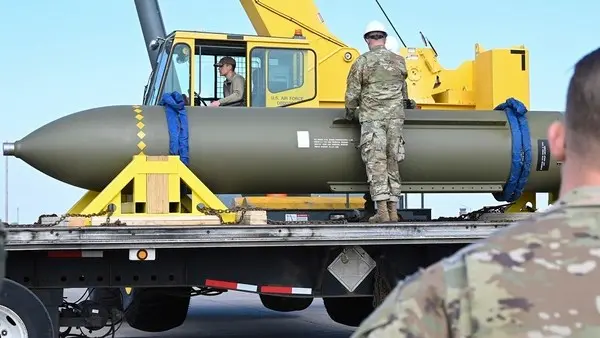
WASHINGTON – The U.S. military on Wednesday said that it had struck more than 12,300 targets in Iran during the conflict, which has been ongoing for just over a month.
The U.S. Central Command (CENTCOM), which oversees U.S. forces in the region, said in an update on Wednesday that its forces “Damaged or Destroyed” more than 155 Iranian vessels among the more than 12,300 targets struck since the start of the war. “CENTCOM forces are striking targets to dismantle the Iranian regime’s security apparatus, prioritising locations that pose an imminent threat,” the command said. The Israeli military said on Wednesday that Israel had so far carried out more than 800 strikes in Iran. Israel and the United States have been attacking Iran since Feb. 28, with Iran responding with attacks on Israel and U.S. allies in the Gulf region. (dpa/NAN)
Tag:
U.S military
Moghalu Defends U.S. Anti-Terror Strike in Sokoto, Says Nigeria’s Sovereignty Was Already Undermined
by Editor
written by Editor
By Chibuike Nwabuko
ABUJA (PRECISE POST) – Former Deputy Governor of the Central Bank of Nigeria, Professor Kingsley Moghalu, has weighed in on the controversy surrounding the United States military intervention against terrorists in Sokoto on December 25, 2025, arguing that the debate over Nigeria’s sovereignty misses the core of the country’s security crisis.
Reacting to criticisms that the American operation violated Nigeria’s sovereignty on his X handle on Saturday @MoghalyKingsley, Moghalu contended that such arguments overlook a more fundamental reality: Nigeria’s sovereignty had long been eroded by terrorists who seized control of vast ungoverned spaces across the country.
According to him, insurgent groups have, for years, operated freely in territories such as the Sambisa Forest and parts of the Northwest and Northeast, in some cases imposing taxes and parallel authority over Nigerian citizens. He questioned why this sustained loss of territorial control and the mass killing of Nigerians of all faiths failed to provoke the same outrage now being directed at foreign military intervention.
“If sovereignty was not considered violated when terrorists controlled Nigerian territory and destroyed lives for over 16 years, then sudden concern about sovereignty in response to a counter-terror operation amounts to crocodile tears,” Moghalu argued.
He further noted that the sovereignty argument is significantly weakened by the reported cooperation between the Nigerian government and military and the United States in carrying out the strikes. Whether such cooperation was entered into willingly or emerged as a fait accompli, he said, it effectively provides diplomatic and legal cover for all parties involved.
Moghalu stressed that sovereignty cannot exist in name alone. “Sovereignty is meaningless when a state cannot control its territory or protect its citizens from attack,” he said, describing Nigeria’s predicament as one in which sovereignty has become more theoretical than real.
Precise Post recalls that beyond the immediate debate, Moghalu emphasized that the real challenge lies in how Nigeria can reclaim and reestablish effective sovereignty over its territory while safeguarding the lives and property of its citizens. He described the U.S. intervention as only an initial step in addressing a deeply complex security problem that will require sustained, long-term strategies.
Central to such a strategy, he argued, is the urgent task of building genuine nationhood—one that fosters a shared worldview, unity of purpose, and a commitment to the equal worth of all Nigerian lives.
He warned that Nigeria’s security woes are exacerbated by deep-rooted sectionalism, religious irredentism, and an entrenched “us versus them” mentality. According to him, the tendency of influential actors to prioritize narrow sectarian identities over a pan-Nigerian identity undermines collective security and leaves the country vulnerable to extremist violence.
“This is shadow-chasing, and it must end,” Moghalu said, adding that while citizens all have a role to play, the primary responsibility for restoring security and sovereignty rests squarely with the political leadership of the Nigerian state.
Moghalu further stressed that without decisive leadership and a renewed commitment to national unity, debates over sovereignty will remain hollow, even as terrorism continues to threaten the foundations of the Nigerian state.