
By Our Reporter
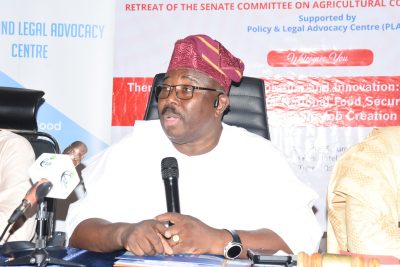
Abuja, February (Precise Post) — Chairman of the Senate Committee on Agricultural Colleges and Institutions, Sharafadeen Abiodun Alli, has called for a comprehensive overhaul of Nigeria’s Agricultural Colleges and Institutions (ACIs), urging stakeholders to transform the institutions into engines of innovation, food security and sustainable job creation.
Speaking at the 2026 retreat for committee members and heads of Agricultural Colleges and Institutions held at Villa Park Hotel, Abuja, Senator Alli said the nation’s agricultural education system must be repositioned to meet modern economic realities.
The four-day retreat, which followed the conclusion of deliberations on the 2026 national budget, provided an opportunity for ACIs to review their 2025 budget performance and defend their 2026 proposals.
From Theory to Productivity
Addressing participants, Senator Alli stressed that the theme of the retreat — “Fostering Collaboration and Innovation: Re-Engineering ACIs’ Capacity for National Food Security and Sustainable Job Creation” — reflects an urgent national priority rather than a ceremonial slogan.
He noted that for years, agricultural institutions have struggled with outdated frameworks and chronic underfunding, limiting their capacity to contribute meaningfully to national development.
According to him, re-engineering the institutions requires:
Modernizing research to produce field-ready, commercially viable solutions rather than purely academic outputs;
Integrating precision agriculture, artificial intelligence and data analytics to mitigate the impact of climate change on crop yields;
Upgrading laboratories and demonstration farms to align with 21st-century global agribusiness standards.
He emphasized that agricultural colleges must evolve beyond theoretical learning centres into hubs of productivity and innovation capable of driving Nigeria’s food security agenda.
Senator Alli also highlighted the urgent need to address youth unemployment, describing it as a “ticking time bomb” given Nigeria’s large youthful population.
He said agricultural institutions hold the key to reversing the trend by shifting focus from producing job seekers to graduating “agri-preneurs” capable of building value-chain enterprises and creating jobs.
“Our goal is to establish a sustainable pipeline where graduates do not depend on government employment but become employers of labour,” he stated, adding that stronger linkages between academia and practical agriculture are essential to achieving this objective.
The Committee Chairman acknowledged that innovation requires adequate financing and that existing funding models are insufficient to meet the scale of transformation required.
He called for candid discussions during the retreat on:
Strengthening public-private-academic partnerships to attract private sector investment in agricultural research;
Improving the competitiveness of ACIs in securing international grants, particularly for climate-resilient initiatives;
Advancing legislative advocacy to reposition agricultural education as a high-yield investment rather than a social service expenditure.
Senator Alli disclosed that resolutions from the retreat would form the framework for a National Summit scheduled later this year, where a legislative roadmap for agricultural education reform will be presented for adoption.
He said the retreat would serve as a platform for policy synchronization to ensure that laws enacted by the National Assembly are practical, impactful and aligned with institutional realities.
The lawmaker expressed appreciation to the President of the Senate, Godswill Obot Akpabio, for providing leadership and enabling the committee to function effectively. He also commended members of the committee and development partners for their support.
Special recognition was given to the Policy and Legal Advocacy Centre (PLAC), led by Executive Director Clement Nwanko, and United Kingdom International Development (UKID) for their collaboration on the retreat.
Precise Post recalls that Senator Alli urged participants to deliberate with urgency and patriotic commitment, noting that the expectations of farmers, unemployed youths and millions of Nigerians facing food insecurity rest on the outcome of their engagements.
“The hopes of our farmers, our unemployed youth, and a famished nation rest upon our shoulders,” he said, calling for collective action to elevate Nigeria’s agricultural education to the next stage of national development.
Senate Committee Pushes Overhaul of Agricultural Colleges to Drive Food Security, Job Creation
36

