
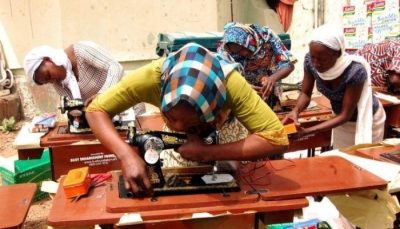
ABUJA – Dr Olushola Odusanya, Director-General, National Centre for Technology Management (NACETEM), says Nigeria should prioritise vocational skills development to bridge employment gap, strengthen industrial productivity and benefit from foreign investments.
Odusanya said this on Tuesday in Abuja during an in an interview with newsmen.
He said it was imperative for the nation’s education and labour systems to shift focus from academic qualifications to practical and globally certified skills.
He said that over 70 per cent of available jobs in most industries required vocationally trained workers, not just those with academic qualifications.
“When we talk about unemployment, we must realise that most jobs are for vocationally skilled people.
“For example, in a typical hospital, you have few doctors and nurses, but the majority are technicians and support staff who do not have degrees. That is the true picture of the labour market,” he said.
The NACETEM boss said the agency recently conducted a job gap analysis of the oil and gas sector and identified four critical vocational skills needed to drive national growth.
He said they included welding, foundry, industrial electrical work and mechatronics.
“For Nigeria to move from where it is now, we need to accelerate training in these four skills.
“Investors are coming into the country, but without qualified technicians, they will import workers from abroad and that is what we are trying to prevent,” he told NAN.
He further revealed that NACETEM’s analysis of the oil and gas sector showed a demand for over 300,000 certified welders.
“The jobs are there, but industries will not hire unskilled people and that is why we still have unemployment in the midst of opportunities. We must marry academic knowledge with practical skills,” he said.
He said that Nigeria’s overemphasis on academic certificates had weakened the nation’s technical workforce.
“The average engineer in Nigeria is a mathematician because they spend more time on mathematics than on engineering practice.
“The skills component in many tertiary institutions is weak and our vocational institutions are converting to universities because of funding incentives from government,” Odusanya said.
He added that NACETEM had developed innovative models to make global certification more affordable, including the use of welding simulators to reduce training costs.
“Before you get a global welding certificate, you will have to use materials worth about 2,000 dollars but to save that cost we introduced simulation.
“Trainees now learn on simulators before handling real materials and this saves up to one-third of the cost,” he explained.
Odusanya said that empowering young people with vocational skills would not only reduce unemployment but also prepare Nigeria for the demands of an emerging global economy.
“The economy is evolving; when the growth speed comes, there will be a shortage of workers. We are preparing for that future now,” he said. (NAN)

