
By Clement Nwabuko
ABUJA (PRECISE POST) – Former Corps Marshal of the Federal Road Safety Corps (FRSC), Osita Chidoka, has expressed satisfaction with the agency’s continued commitment to institutional excellence, accountability and quality service delivery, 13 years after it became the first law enforcement agency in Africa to obtain ISO 9001 quality management certification.
Chidoka said he was encouraged by the ongoing efforts of FRSC officers to sustain the standards established during his tenure, noting that the commitment of his successors demonstrated the importance of building institutions capable of outliving their founders.
In a statement posted on his X handle on Wednesday, November 18, 2026, Chidoka recounted how a telephone conversation with a former colleague at the Corps, whom he contacted while at the Abuja airport, brought him unexpected news about an ongoing ISO 9001 audit in Onitsha, Anambra State.
According to him, the officer disclosed that FRSC personnel were busy attending to an external audit aimed at determining whether the Corps had addressed shortcomings identified during an earlier assessment.
Chidoka, who was travelling to Anambra State to deliver an address at the convocation luncheon of the Institute for Peace, Security and Development Studies at Nnamdi Azikiwe University, said the development reinforced his belief that the institutional reforms introduced during his tenure had endured.
“What she said made my day. In Onitsha, far from the nation’s capital, officers of a government agency were accounting for how they did their work. I heard about it only because I happened to call,” he said.
Reflecting on his tenure as Corps Marshal, Chidoka recalled that the FRSC’s attainment of ISO 9001 certification 13 years ago was driven by his determination to establish clear operational standards and reduce excessive dependence on the discretion of individual officers.
He explained that the objective was to institutionalise processes that would continue to guide the Corps irrespective of changes in leadership.
“As Corps Marshal, I wanted us to agree on how our work should be done and leave much less to the discretion of whoever was in charge,” he stated.
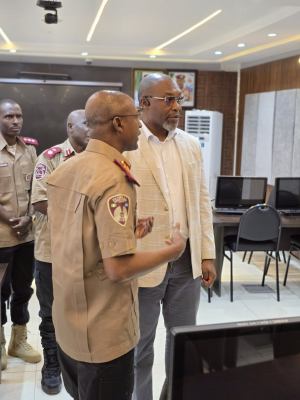
Chidoka also recalled his visit to the FRSC headquarters in December 2024 to renew his driver’s licence, during which he observed improvements in the agency’s facilities and technological infrastructure.
He said he was particularly impressed by the investments in technology and the commitment of the current Corps Marshal, Shehu Mohammed, to improving operational efficiency.
According to him, the experience reinforced his confidence in the leadership of the Corps and its determination to build on the institutional foundations inherited from previous administrations.
Commending his successors and serving officers, Chidoka said the ongoing efforts to sustain the agency’s standards were evidence that meaningful leadership should be measured not merely by immediate achievements but by the ability to establish structures that endure.
“I often think we judge what we have built too early, usually while we are still in office. Sometimes it takes a decade to see what has endured,” he observed.
He added that the greatest responsibility of leadership was to lay a solid foundation for successors or strengthen the structures inherited from predecessors.
“I believe the most important work a leader can do is to lay a foundation others can build on, or to add a few sound blocks to the one they inherit.

