
By Our Reporter
ABUJA (PRECISE POST) – The government of the People’s Republic of China has pledged comprehensive technical and diplomatic support for Nigeria’s push to modernise and fully automate operations across its seaports, a move that signals a deepening strategic partnership between both nations in the maritime sector.
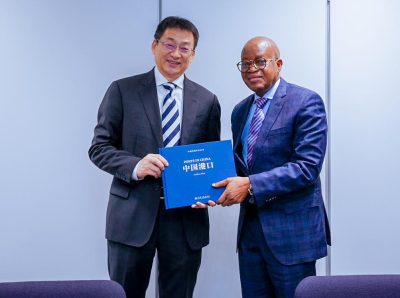
The commitment was announced during a bilateral meeting between China’s Vice Minister of Transport, Li Yang, and Nigeria’s Minister of Marine and Blue Economy, Dr Adegboyega Oyetola, held on Monday, 24 November 2025, on the sidelines of maritime engagements in London. The details were contained in a statement issued Tuesday by the Special Adviser to the Minister, Dr Bolaji Akinola.
Li Yang praised President Bola Ahmed Tinubu for creating a standalone Ministry of Marine and Blue Economy, describing it as a transformative decision for Nigeria’s maritime future. He noted that China, which currently operates 52 fully automated ports, one of the highest globally, possesses the technology, expertise and experience necessary to help Nigeria transition from manual and semi-automated processes to a fully digital port environment.
He said China’s automated ports have significantly boosted trade efficiency, reduced vessel turnaround time, improved security through smart surveillance, and minimised human error via integrated digital platforms. A customised version of these solutions, he added, could unlock new layers of competitiveness for Nigeria’s economy.
The Chinese Vice Minister outlined areas where China is ready to support Nigeria, including smart port infrastructure, cargo-handling automation, digital gate and customs systems, and advanced maritime communication technologies.
Li Yang also reaffirmed China’s strong support for Nigeria in the upcoming International Maritime Organisation (IMO) Council election scheduled for Friday, 28 November, and commended the longstanding partnership between both countries. He noted the active presence of Chinese companies in Nigeria’s rail, road and port construction sectors, describing their contributions as central to Nigeria’s infrastructural development.
Beyond technical support, China also announced opportunities for maritime education, including scholarships under its specialised maritime training scheme and placements in the Global Innovation in Transport Programme, a four-week intensive industry course for young professionals. He further invited Dr Oyetola to the 2026 Sustainable Transport Summit in China and revealed that a draft Memorandum of Understanding is underway to formalise expanded maritime cooperation.
Responding, Minister Oyetola expressed appreciation for China’s backing, particularly its pledge of support for Nigeria’s IMO Council bid, and assured that Nigeria would reciprocate the goodwill.
He highlighted Nigeria’s readiness to deepen collaboration in port digitalisation, maritime safety, shipbuilding and repair, inland waterways, seafarer development, blue economy investments and environmental protection. Oyetola also noted that Nigeria has recorded zero piracy incidents in its waters over the last four years, with improved security across the Gulf of Guinea, attributing the progress to surveillance, regional cooperation and the Deep Blue assets.
The Minister sought China’s assistance in tackling Illegal, Unreported and Unregulated (IUU) fishing through satellite tracking, modern monitoring technologies and joint enforcement initiatives. He also called for Chinese partnership in developing Nigeria’s fisheries and aquatic resources, a key pillar of its blue economy strategy.
Both countries concluded the meeting with a shared commitment to strengthen maritime ties and advance towards signing a new bilateral Memorandum of Understanding that will define emerging areas of cooperation.

