
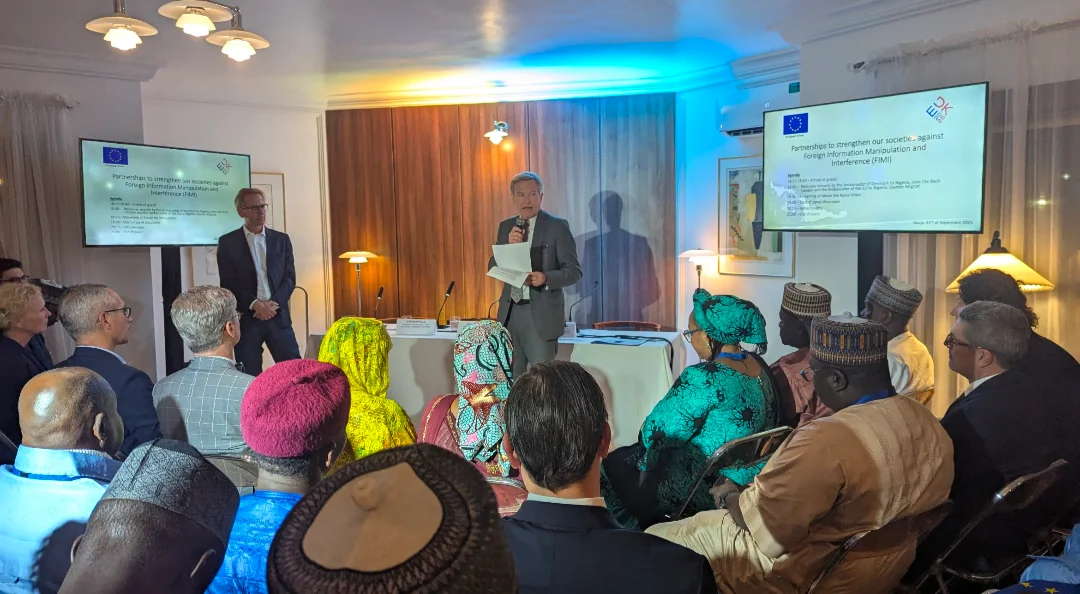
ABUJA – The European Union (EU) has trained 125 journalists, Civil Society Organisations (CSOs) and students across northern states on resilience against Foreign Information Manipulation and Interference (FIMI).
Mr Gautier Mignot, the EU Ambassador to Nigeria and the Economic Community of West African States (ECOWAS), stated this at the closing of the 2-day training workshop on Friday in Abuja.
He said the training, organised in collaboration with EU member states, targeted northern Nigeria due to the rising threat of disinformation, which he described as a danger to democracy, stability and security.
Mignot said disinformation campaigns were often designed to incite hatred, fuel rejection and create rifts between nations, adding that such manipulations must be detected and debunked without undermining freedom of expression.
“This phenomenon is not anecdotal; it is serious because those behind it aim to destabilise democracies, create divisions, and incite hostility,” he noted.
According to him, the workshop drew about 125 participants, half of whom were journalists and students, while the rest comprised CSOs, officials and diplomats.
He said that the participants were expected to step down the training to their peers, thereby building a wider network of resilience against disinformation across Nigeria.
Also speaking, Mr Viktoras Dauksas, Head of the Disinformation Analysis Centre, debunk.org, said the training equipped participants with tools to identify and counter FIMI campaigns, including artificial intelligence-generated images and videos.
He noted that disinformation was increasingly being used by authoritarian actors to manipulate citizens and destabilise countries, stressing that journalists play a critical role in safeguarding democracy.
“Our goal is to help journalists and analysts spot systematic campaigns, report accurately, and inform citizens to prevent manipulation,” Dauksas said.
On his part, Mr Johannes Lehne, Deputy Head of Mission, German Embassy in Abuja, said insecurity in northern Nigeria was worsened by misinformation, which often misled citizens and fuelled extremist ideologies.
He explained that misinformation contributed to humanitarian crises and migration challenges that extended to Europe, making it a shared concern (NAN)

