
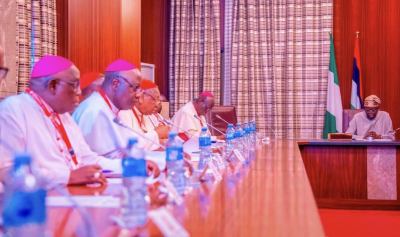
By describing Cardinal John Onaiyekan’s comments after the Catholic Bishops’ Conference of Nigeria’s meeting with President Bola Ahmed Tinubu as an “abuse of clerical privilege,” Presidential spokesman Temitope Ajayi has done more than criticise a respected cleric. He has inadvertently promoted a dangerous idea—that those who enjoy access to power must surrender their right to speak truthfully to the public once they leave the room.
That proposition has no place in a constitutional democracy.
The office of a cardinal does not strip its holder of the rights guaranteed under the Constitution. Nor does a meeting with the President impose an oath of silence unless classified matters are discussed. Cardinal Onaiyekan neither leaked national security secrets nor disclosed confidential intelligence. He simply shared his impression of an engagement centred on the state of a nation that belongs to all Nigerians, not the Presidency alone.
To describe that as an “abuse of clerical privilege” is to weaponise language against legitimate democratic engagement.
The Catholic Bishops did not seek an audience with the President to negotiate church appointments or secure financial concessions. They went to the Presidential Villa because millions of Nigerians are groaning under the weight of economic hardship, rising insecurity, soaring food prices, unemployment, and declining living standards. Their intervention was not partisan; it was pastoral. They spoke not only for Catholics but for countless Nigerians whose daily experiences have become increasingly difficult.
That is precisely what religious leaders are expected to do.
Throughout Nigeria’s history, the Church has stood as one of the nation’s moral compasses. During military dictatorship, church leaders condemned arbitrary arrests, election annulments, corruption, and abuses of power. Many of those who today occupy public office applauded such courage because it challenged governments they opposed. It is therefore ironic that similar moral interventions are now being portrayed as improper simply because they concern an elected government.
A moral voice does not cease to be legitimate because it becomes uncomfortable to those in power.
Ajayi argues that President Tinubu possesses intelligence unavailable to the bishops and therefore has a better understanding of Nigeria’s security situation. No one disputes that the Commander-in-Chief receives classified briefings.
But intelligence reports cannot invalidate lived reality.
No intelligence file can persuade a farmer driven from his land by armed bandits that security has substantially improved. No classified document can convince a mother who skips meals so her children can eat that economic hardship is merely a perception. No operational briefing can erase the trauma of communities devastated by violent attacks or persuade victims of kidnapping that statistics are more important than their suffering.
Government data matters. Citizens’ experiences matter even more.
Yes, the Tinubu administration has implemented reforms. State revenues have increased. The Student Loan Scheme has expanded educational financing. Fiscal adjustments have stabilised aspects of public finance. These are legitimate achievements that deserve acknowledgement.
But governments do not earn public confidence merely by announcing reforms; they earn it when citizens begin to feel the benefits in their homes, businesses, farms, schools, hospitals, and markets.
That remains the central question.
The Presidency’s response also betrays a worrying assumption—that because the President reads newspapers, receives intelligence briefings, and consults advisers, independent voices are somehow unnecessary.
History teaches exactly the opposite.
Governments become isolated not because they lack information but because they begin to believe official reports more than the lived experiences of ordinary citizens. Every administration possesses briefing papers. Every government has statistics. Yet history is replete with leaders who were shocked by public discontent because they mistook official optimism for national reality.
This is precisely why democracies need an independent press, labour unions, professional associations, civil society organisations, traditional rulers, academics, and religious leaders. Their role is not to flatter government but to challenge it when necessary.
Democracy does not require applause. It requires accountability.
Equally troubling is Ajayi’s suggestion that Cardinal Onaiyekan violated the dignity of a private meeting by speaking publicly afterwards.
That argument collapses under the weight of established practice.
Governors routinely brief journalists after meetings with the President. Ministers address the media after Federal Executive Council deliberations. Labour leaders publicly recount negotiations with government. Business executives speak after consultations at the Presidential Villa. Foreign diplomats issue statements after presidential engagements. Political leaders routinely narrate discussions held behind closed doors.
None of these has ever been described as an abuse of privilege.
Why should a cardinal be held to a different standard?
If anything, citizens deserve to know whether those they trust to represent their concerns actually confronted government with difficult truths. Transparency strengthens democracy; secrecy weakens it.
Most disturbing, however, is the attempt to reduce religious leaders to ceremonial figures whose role is to offer prayers, blessings, and compliments while leaving governance entirely beyond moral scrutiny.
That has never been the mission of the Church.
From the Hebrew prophets who confronted unjust kings to Christian leaders who challenged apartheid, colonialism, dictatorship, and systemic injustice across the world, the Church has always insisted that political authority must remain accountable to moral authority.
Silence in the face of suffering is not neutrality. It is complicity.
No serious observer believes the Catholic Bishops possess a monopoly on truth. They have never claimed to. But neither does the Presidency possess a monopoly on reality.
The true test of democratic leadership is not how vigorously it rebuts criticism. It is how confidently it tolerates criticism without attempting to delegitimise those who speak.
Calling Cardinal Onaiyekan’s interview an abuse of clerical privilege misses the real issue. The real issue is whether Nigerians are safer, whether families can afford food, whether businesses are surviving, whether young people can find jobs, and whether citizens genuinely feel the promised dividends of governance.
Those are the questions the bishops raised.
Those are the questions millions of Nigerians continue to ask.
Attempting to silence the messenger will not answer them.
A confident government should welcome honest criticism, engage it with evidence, and allow Nigerians to judge. That is the essence of constitutional democracy. It is also the hallmark of mature leadership.
The Church has every right to speak. The Presidency has every right to disagree.
What neither should do is suggest that moral truth becomes inappropriate simply because it makes political power uncomfortable.
This version is more assertive while staying focused on constitutional principles, democratic norms, and the distinction between criticism of government and criticism of the presidency as an institution.
Comrade Chibuike Nwabuko is a political analyst and rights crusader, writes in from Abuja. He can be reached on [email protected]

