
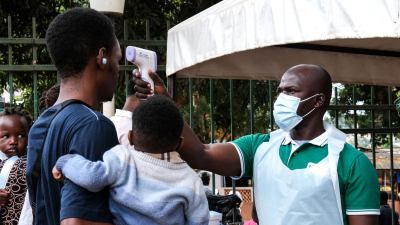
ABUJA – The World Health Organisation (WHO) has raised the risk of the Bundibugyo strain of Ebola spreading across the Democratic Republic of Congo (DRC) to “very high” at the national level and high at the regional level for DRC, with low global risk.
WHO Director-General, Dr Tedros Ghebreyesus, said this on Friday during an online media briefing on outbreaks of Ebola and hantavirus.
Ghebreyesus said that there were 82 confirmed cases and seven deaths, but that nearly 750 suspected cases and 177 suspected deaths suggested the outbreak was larger.
According to him, the outbreak can increase rapidly with no approved vaccine or treatment available, though health officials are doing all to contain the virus and prevent wider regional spread.
“This outbreak is caused by Bundibugyo virus, not Zaire.
“There are no approved vaccines or therapeutics for Bundibugyo, and only two previous outbreaks have occurred Uganda in 2007 and DRC 2012.
“ Uganda’s situation is stable with two confirmed cases linked to DRC travel and one death.
“Rapid contact tracing and canceled public events seem to have contained spread.
“Two American nationals are involved: one transferred to Germany for care, another high-risk contact moved to the Czech Republic,” he said.
The WHO boss said that DRC and Uganda were leading the response with WHO and partners support.
According to him, WHO deployed 22 international staff and released 3.9 million dollars from its emergency fund.
Also, UN Humanitarian Chief, Tom Fletcher, allocated 60 million dollars to the response.
He said that WHO was supporting contact tracing, treatment centers, risk communication, and community engagement.
The DG said that a Continental Incident Management Support Team was being set up with Africa CDC, and a multi-agency Strategic Preparedness and Response Plan would be published soon.
“ WHO’s R&D Blueprint recommended advancing two monoclonal antibodies into trials and evaluating the antiviral obeldesivir for post-exposure prophylaxis in high-risk contacts.
“The trial is being developed with Africa CDC and the collaborative Open Research Consortium on filoviruses. Vaccine candidates are also under discussion,” he said.
According to him, the outbreak is in Ituri and North Kivu, where intensified fighting has displaced no fewer than 100,000 people.
He said that across both provinces, four million people needed urgent aid, two million were displaced, and 10 million faced acute hunger.
Ghebreyesus said that there was significant distrust of outside authorities locally.
“Yesterday a hospital in Ituri was attacked, with tents and supplies set on fire. Building trust and maintaining essential health services are top priorities.”
The DG said that WHO updated on a hantavirus outbreak aboard the MVHondius cruise ship.
He said that the Netherlands confirmed one more crew case, bringing totals to 12 cases and three deaths.
“No deaths have occurred since May 2”.
According to him, no fewer than 600 contacts are being followed in 30 countries, with a few high-risk contacts still being located.
“WHO thanks Argentina, Cabo Verde, Chile, Netherlands, South Africa, Spain, the UK, and the EU for cooperating in the investigation and response.
“That keeps the risk assessment, case numbers, virus type, response actions, funding, medical countermeasures, security situation, and hantavirus updated,” he said.(NAN)

