
By Chibuike Nwabuko
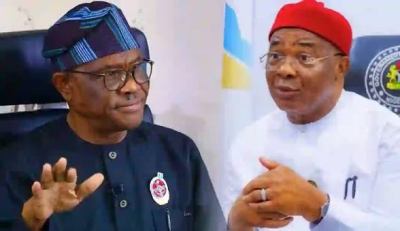
The growing political confrontation between the Minister of the Federal Capital Territory, Nyesom Wike, and some governors elected on the platform of the All Progressives Congress, (APC), may be more consequential than it presently appears. If left unresolved, the dispute could create the kind of internal political friction capable of complicating President Bola Ahmed Tinubu’s 2027 re-election project.
At the centre of the disagreement is a simple but potentially explosive question: how far should individual politicians go in pursuing their political interests when those interests begin to collide with the interests of others who are expected to work toward the same presidential objective?
Wike has repeatedly maintained that his Rainbow Coalition is designed to support Tinubu’s re-election while allowing opposition parties and politicians to contest governorship and legislative seats against APC candidates. The APC governors, led by the Progressive Governors Forum, have taken a different position, insisting that their campaign commitment is to APC candidates at every level.
On the surface, both sides say they support Tinubu. But politics is rarely determined by presidential support alone. Behind every presidential election are governors, senators, House of Representatives members, state legislators, party structures, local political networks and thousands of interests that converge around the ballot.
That is where the danger lies.
Tinubu cannot afford a situation in which people working for his presidential victory are simultaneously engaged in political warfare against one another in the states.
If Wike deploys his political machinery in a manner that threatens the electoral or succession plans of APC governors, those governors may have reasons to protect their own political interests. And if the governors, in turn, use their state structures to frustrate Wike’s political calculations, the dispute could become a cycle of retaliation in which everyone claims to be protecting his interest while the President’s larger political project becomes collateral damage.
The most important lesson for all sides is therefore that political influence must have limits.
Wike, as a political actor and a cabinet member of the Federal Government, has every right to pursue his political interests and support the presidential candidate of his choice. But that political influence should not become an instrument for unnecessarily dismantling the political calculations of governors in their respective states.
The same principle applies to the governors. Their control of APC structures and state political machinery should not be interpreted as a licence to suffocate every competing political interest simply because such interests are not convenient to them.
The reasonable approach should be a political understanding: let Wike pursue his political objective without deliberately upsetting the governors’ legitimate state interests, while the governors should pursue their own electoral objectives without treating every political structure outside the APC as an enemy of Tinubu.
There is already evidence that the disagreement has become sufficiently serious to attract national attention. Recall that Wike has criticised some APC governors and specifically clashed with Imo State Governor Hope Uzodimma over political ambitions and the Rainbow Coalition. The governors, on their part, have publicly declared that they will not support arrangements capable of weakening the APC or adversely affecting its candidates.
That is a dangerous trajectory because political loyalty is not always transferable from one ballot paper to another. A governor who is fighting desperately to secure his political future may be less enthusiastic about an arrangement that threatens his succession plans. A politician whose candidates are being undermined may eventually begin calculating how best to protect his own political survival.
This is where the possibility of a “secret spoiler” effect emerges.
If a governor concludes that the defeat of a particular political structure is necessary to preserve his own political future, the presidential contest could become entangled with that calculation. Such a governor may publicly proclaim support for Tinubu while simultaneously concentrating his political energy on local contests that serve a different objective.
That does not automatically mean that any governor would deliberately work against Tinubu. It means that the more intense the struggle among the political actors, the greater the possibility that state-level calculations could conflict with the President’s national electoral objective.
And there is an important political paradox here: if Tinubu fails to return to office in 2027, the political fortunes of many of those currently fighting for influence around him would also be affected. Wike’s influence at the federal level, for instance, is closely connected to the political environment created by the Tinubu administration. Likewise, APC governors seeking continuity, influence and relevance beyond their present terms need a political environment that protects the larger ruling-party project.
This is why allowing the dispute to degenerate into a full-scale political confrontation would serve neither camp in the long run.
The President therefore has a difficult but necessary responsibility: he should not sweep the disagreement under the carpet. A disagreement that is ignored because everyone involved currently claims to support the President can eventually become more difficult to resolve when candidates, tickets, primaries and campaign structures become fully activated.
Tinubu does not necessarily have to choose between Wike and the governors. Rather, he needs to establish a political understanding that recognises the legitimate interests of both sides while drawing a line against actions capable of deliberately destabilising the other. The message should be straightforward: support the President, but do not destroy one another in the process.
Wike should be allowed to build whatever political coalition he considers necessary for the presidential contest, but his allies should understand that governors also have legitimate political constituencies and succession plans.
The governors, likewise, should understand that Wike’s political influence cannot simply be wished away because he is not an APC governor. His capacity to mobilise politicians across party lines is already part of the current political equation, and attempts to completely shut him out could deepen rather than resolve the confrontation. Recent reporting indicates that the dispute has already attracted aggrieved APC politicians and created concerns within the ruling party about competing political structures.
The solution, therefore, is not for either side to surrender its political interest. It is for both sides to define the limits of that interest.
Politics is fundamentally about negotiation, accommodation and survival. Nobody’s political plan should automatically become another person’s political problem. But equally, nobody should expect other politicians to surrender their own political future simply because one powerful actor has developed a different strategy.
For Tinubu, the greatest risk is not necessarily Wike’s Rainbow Coalition or the governors’ opposition to it in isolation. The greater risk is the possibility that both political structures could become so consumed by their rivalry that they lose sight of the presidential election they claim to be preparing for. A divided political family can spend so much energy fighting over who controls the house that it forgets that someone else may be waiting outside to take advantage of the quarrel.
The 2027 election will ultimately be decided by voters. But political organisations determine how effectively candidates reach those voters. If the people controlling those structures are engaged in an internal battle, the consequences could extend well beyond the immediate dispute.
Wike and the APC governors therefore need to draw a political line around their respective interests. Fight for your candidates, protect your constituencies and pursue your ambitions—but do not turn every disagreement into a battle for political annihilation.
And President Tinubu should take the warning seriously.
The objective should be reconciliation before retaliation becomes the dominant language of the relationship. Because if Wike believes he can continually ruffle the feathers of governors without consequences, and the governors conclude that they must retaliate to protect their political survival, the resulting escalation could produce consequences that none of the actors originally intended.
Ultimately, the Tinubu 2027 project may require not just mobilisation, but political restraint.
Those who genuinely want the President back in office must recognise that there is a difference between competing for political space and destroying the political space of those who are expected to work with you. The earlier that distinction is understood by both Wike and the APC governors, the easier it will be to prevent today’s disagreement from becoming tomorrow’s electoral liability.
.

