
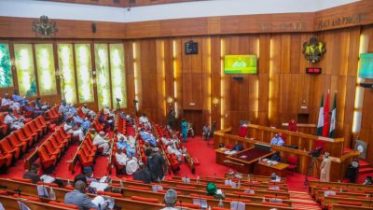
President of the Senate, Godswill Akpabio, has said the National Assembly will take decisive legislative action and intensify oversight to ensure Nigeria fully benefits from the African Continental Free Trade Area.
Akpabio spoke at the opening of a three-day capacity-building workshop on “The Role of Lawmakers in the National Implementation of the AfCFTA Agreement and its Eight Associated Protocols.” The event was organised by the National Institute for Legislative and Democratic Studies in collaboration with the United Nations Economic Commission for Africa.
Represented by Senator Ibrahim Khalid, the Senate President said international agreements would remain ineffective without proper domestication and sustained parliamentary scrutiny.
“A single market of over 1.4 billion people presents immense possibilities, but treaties will not implement themselves. Implementation must follow ratification,” he said.
Akpabio described AfCFTA as a historic opportunity to reposition Africa’s economy but stressed that the National Assembly must translate continental commitments into tangible national outcomes.
According to him, lawmakers must thoroughly examine AfCFTA protocols, enact strategic legislation and strengthen oversight to protect Nigeria’s interests while unlocking the benefits of the continental market.
He also called for a review of existing trade, customs, competition, intellectual property and digital commerce laws to ensure alignment with Nigeria’s obligations under the agreement, while safeguarding vulnerable sectors and small businesses.
Speaker of the House of Representatives, Tajudeen Abbas, also highlighted the legislature’s role in driving implementation of the agreement.
Represented by Hon. Rabiu Yusuf, Chairman of the House Committee on Treaties, Agreements and Protocols, Abbas described AfCFTA as one of Africa’s most ambitious economic integration initiatives.
He said the success of the agreement would depend largely on coordinated national implementation, noting that legislative backing is necessary to make treaty commitments operational.
The Speaker further pointed to the National Assembly’s constitutional authority over appropriation, stressing that adequate funding would be needed for customs modernisation, support for micro, small and medium enterprises (MSMEs), trade infrastructure and data systems for monitoring and evaluation.
Speaking on behalf of the Minister of State for Industry, Trade and Investment, Senior Special Assistant on Policy, Dr. Deji Adeshile, said Nigeria’s Industrial Policy 2025 places trade competitiveness and regional integration at the centre of the country’s industrial transformation agenda.
Delivering the keynote address on behalf of the Executive Secretary of UNECA, Prof. Melaku Desta said the success of AfCFTA would ultimately depend on effective national implementation.
He noted that empirical projections show significant potential growth in intra-African trade under the agreement but warned that such gains would only materialise if member states fully comply with legal and regulatory commitments.
Earlier, Director-General of NILDS, Prof. Abubakar Suleiman, said AfCFTA represents one of Africa’s most far-reaching economic initiatives in recent history.
He stressed that legislatures play a critical role in the domestication of international agreements, passage of enabling laws, budget approvals and oversight of implementation.
The three-day workshop is expected to deepen lawmakers’ understanding of AfCFTA’s eight protocols, clarify Nigeria’s obligations and strengthen the capacity of parliamentary staff to provide technical and research support.
Participants include senators, members of the House of Representatives, clerks, legislative aides and trade policy experts.
Stakeholders expressed optimism that the engagement would lead to concrete legislative reforms aimed at positioning Nigeria as a major beneficiary of the continental trade pact.

