
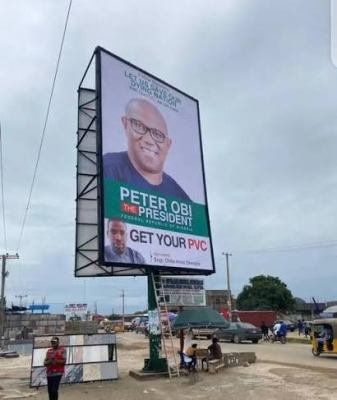
ENUGU – Some stakeholders in Enugu State have decried the high fees imposed by some governments for outdoor campaign posters and billboards ahead of the 2027 general elections.
The stakeholders, who spoke in separate interviews with newsmen on Saturday in Enugu, described the fees as “executive rascality” and an attempt to stiffle opposition parties as well as democratic principles.
Reports that the Federal Capital Territory (FCT) Administration on Friday fixed N750 million as permit fee for presidential campaign billboards and posters in Abuja, while Enugu State Government set its fee at N150 million.
In Abia, the government fixed permit fees at N200 million for presidential candidates, N150 million for governorship candidates, N100 million for senatorial candidates, N50 million for House of Representatives candidates and N20 million for House of Assembly candidates.
Similarly, the Anambra State Government fixed N50 million for presidential candidates seeking outdoor campaign permits, while senatorial candidates are expected to pay N20 million.
Reacting to the development, a human rights lawyer, Mr Awforkansi Nnadiume, described the policy as “political hostility” capable of undermining the country’s democratic process.
According to him, the fees are inconsistent with the spirit of the Electoral Act, which prescribes spending limits for election campaigns.
“When governments impose such huge amounts for campaign posters and billboards, they are effectively denying opposition parties the opportunity to communicate their manifestoes to the electorate.
“This amounts to stifling freedom of expression and free speech guaranteed under Chapter Four of the Nigerian Constitution.
“It is one of the strategies capable of pushing Nigeria towards a one-party state because only those in power will dominate public spaces with campaign materials,” he said.
Nnadiume noted that while the restrictions might compel opposition parties to rely more on social media, they nevertheless constituted an infringement on constitutional rights.
He also expressed concern that similar restrictions could be extended to electronic media through sanctions on broadcasters, thereby limiting political competition.
Also speaking, the President of the Civil Rights Realisation and Advancement Network (CRRAN), Mr Olu Omotayo, said the high permit fees were inconsistent with the principles of free, fair and credible elections.
According to him, every political party and candidate should have equal opportunity to campaign and present their programmes to the electorate.
“When any government imposes outrageous fees before candidates can display campaign posters or billboards, it hinders the freedom of opposition parties to reach voters.
“It is an attack on the constitutional right to freedom of expression and should have no place in a democratic society,” Omotayo said.
The rights activist advised opposition parties and other affected stakeholders to institute legal action to test the constitutionality of the policy.
“I believe this matter should be challenged in court. The judiciary should determine whether governments have the power to impose such prohibitive charges.
“I do not think any court will support measures that undermine democratic participation and political competition,” he added.
A legal practitioner, Mr Nnamdi Ezeagu, also described the development as “executive rascality.”
Ezeagu said a group of lawyers in Enugu was already taking steps to challenge the Enugu State Government’s policy in court.
According to him, the judiciary remained the appropriate avenue for resolving the constitutional issues raised by the permit fees.
He expressed optimism that the courts would provide clarity on the legality of the charges and their implications for democratic governance.
Mr Abuchi Anueyiagu, a political analyst, wondered why some governors were becoming “vindictive and overbearing” in this political dispensation.
“During their own time, were they subjected to such payments? This is absolutely ridiculous and unacceptable,” he queried.
Another analyst, Mr Chigozie Anarado, noted that there was nothing wrong with charging such fees to generate revenue but they should make it affordable.
“Where do they expect them to get such money? This heightens corruption and stretches financial burdens on the candidates after paying huge electoral fees,” he said. (NAN)

