
By Clement Nwabuko
ABUJA (PRECISE POST) – The Clerk to the National Assembly, Kamoru Ogunlana, Esq., has raised concerns over irregularities in staff records, promotion practices, delayed disciplinary actions and coordination challenges between the National Assembly Service Commission (NASC) and the management of the National Assembly.
Ogunlana warned that the challenges, if left unresolved, could undermine institutional stability, administrative efficiency and professionalism in the National Assembly Service.
He called for merit-based appointments and promotions, a unified and verifiable staff database, clearer institutional responsibilities and improved collaboration between the Commission and management.
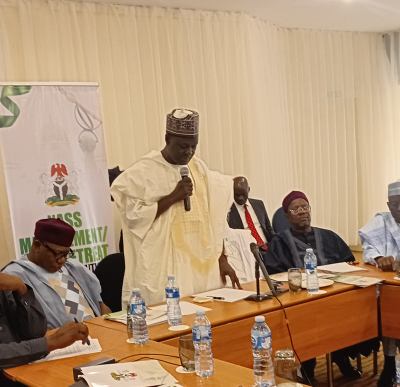
The Clerk sounded the warning on Friday at the opening of a three-day retreat for the National Assembly top management and the National Assembly Service Commission at the Transcorp Hilton Hotel, Abuja.
The retreat, themed “Strengthening Institutional Synergy, Administrative Effectiveness and Professional Service Delivery in the National Assembly,” brought together key stakeholders to deliberate on improving legislative administration and service delivery.
Ogunlana described the retreat as an opportunity to critically examine the National Assembly Service and determine what must change to make it more efficient, accountable, transparent and professional.
The CNA stressed that the effectiveness of the legislature depended not only on the quality of proceedings in the Senate and House of Representatives but also on the competence of personnel, institutional memory, administrative procedures and structures supporting legislative activities.
He said the retreat should provide answers to two fundamental questions: whether the Commission and management were working as closely together as necessary, and what kind of National Assembly Service they intended to bequeath to future generations.
“These are not easy questions, but hopefully, this retreat shall provide us with the opportunity to address them with candour and courage in the interest of the National Assembly Service,” he said.
On human resource management, the Clerk insisted that appointments, promotions and staff development should be guided by merit, competence, experience, performance and the needs of the service.
He warned that allowing considerations outside the National Assembly Service Act 2014 and the applicable Scheme of Service to influence appointments and promotions could lead to judicial reviews, administrative embarrassment and institutional instability.
He also cautioned against situations where seniority, cognate experience and competence were subordinated to geographical origin or other considerations unrelated to professional requirements.
According to him, such practices could leave the institution with too many people occupying positions but too few possessing the requisite capacity to perform effectively.
Describing the situation as an institutional challenge rather than the failure of any individual or administration, Ogunlana called for renewed commitment to transparent career progression, professionalism and due process.
The Clerk also expressed concern over inconsistencies, duplications, contradictions and questionable staff profiles in different nominal rolls circulating within the service.
He called for a single, authoritative, continuously updated and verifiable staff database containing the identity, cadre, grade level, qualifications, appointment and promotion history, postings and training records of every staff member.
He maintained that accurate personnel information was not merely an administrative necessity but a matter of institutional integrity.
Ogunlana identified the relationship between the National Assembly Service Commission and management as another issue requiring urgent attention.
While acknowledging that both institutions had distinct statutory responsibilities, he warned against allowing their differences to create institutional silos.
He explained that the Commission had statutory responsibilities for human resource management, while management was responsible for the day-to-day administration and effective functioning of the National Assembly.
“These responsibilities are complementary. Neither should be regarded as a competing centre of authority,” he said.
He called for a working relationship based on consultation, mutual respect, clarity of roles and shared institutional objectives, particularly in the appointment, promotion and discipline of senior personnel.
He urged participants to use the retreat to clarify the respective responsibilities of the Commission and management in the appointment and deployment of top management staff, noting that the objective was to improve decision-making rather than diminish the authority of either institution.
The Clerk also advocated a clearer understanding of his coordinating role, citing the size and complexity of the National Assembly Service, which he said comprised 3,841 staff, about 12 directorates, 72 departments and four affiliated agencies.
He argued that such a structure required an effective coordination mechanism to prevent duplication, minimise avoidable conflicts and ensure that all components worked towards common institutional objectives.
According to him, the Clerk should serve as an institutional bridge between the political leadership of the National Assembly and the affiliated agencies, including the Commission.
He clarified that the coordinating role should not be interpreted as competing with agencies whose powers were established by law, but as helping them work together more effectively.
He therefore advocated clearly established institutional protocols to ensure that coordination was driven by processes rather than personalities or individual relationships.
On staff discipline, Ogunlana said professionalism, integrity, impartiality and responsible conduct were indispensable to the credibility of Parliament and public confidence in its operations.
He observed that the existing arrangement, under which management supervises staff while formal disciplinary sanctions rest with the Commission, could delay disciplinary action and create disagreements over responsibility when misconduct was not addressed promptly.
He urged participants to examine the arrangement and develop ways of making disciplinary procedures more effective.
The Clerk also proposed that the Commission consider delegating appropriate responsibilities for the appointment, promotion and discipline of junior officers on Grade Levels 3 to 6 to National Assembly management, subject to policy guidelines, oversight and accountability mechanisms.
He said such delegation would enable the Commission to concentrate more on strategic policy matters and the management of senior and critical cadres, while routine personnel matters could be handled more efficiently by management.
“Delegation, properly designed, is not a surrender of authority. It is a means of making authority more effective,” he said.
On staff welfare, Ogunlana called for a coherent framework that would promote fairness and reasonable consistency across the National Assembly Service, while taking account of the financial realities and peculiarities of individual agencies.
He warned against making staff welfare excessively dependent on the personal preferences or circumstances of the chief executive of a particular agency.
The Clerk further called for a more sustainable and coordinated approach to professional development, noting that parliamentary administration was becoming increasingly specialised.
He identified legislative practice, parliamentary procedure, policy analysis, research, digital technology, public financial management, ethics, leadership and emerging global practices as areas requiring continuous staff training.
He described the existing ad hoc approach to training as unsustainable, particularly given limited financial resources.
Ogunlana consequently recommended greater use of the institutional capacity of the National Institute for Legislative and Democratic Studies (NILDS) as the central professional platform for training and developing National Assembly personnel.
He added that training should be linked to career progression, succession planning, performance improvement and the future needs of the institution, rather than merely attending courses.
Reaffirming the need for unity, he said the Commission should provide strategic policy direction, management should deliver professional and efficient administration, while staff should have confidence in a fair and transparent career system.
He urged participants to approach the retreat with openness and a shared commitment to strengthening the National Assembly Service and supporting Nigeria’s democratic aspirations.
Earlier, the President of the Senate, Godswill Akpabio, charged the National Assembly management and the National Assembly Service Commission to strengthen institutional collaboration, improve administrative efficiency and promote accountability in legislative service delivery.
Akpabio, who declared the retreat open, was represented by Senator Babangida Hussaini.
He said the success of the National Assembly depended not only on the quality of its legislative and oversight functions but also on the effectiveness of its administrative structures and the professionalism of its workforce.
According to him, the retreat provided an opportunity for participants to reflect on institutional challenges, strengthen coordination and develop practical strategies for improving the performance of the National Assembly Service.
He stressed that no department, directorate or agency could achieve its full potential in isolation, urging the Commission and management to sustain cooperation and pursue common objectives in the interest of legislative excellence.
“Administrative effectiveness requires us to embrace innovation, improve internal processes, promote accountability and ensure that institutional resources are deployed efficiently,” he said.
Akpabio added that professional service delivery demanded discipline, integrity, competence and an unwavering commitment to excellence.
He encouraged participants to exchange ideas freely and develop actionable resolutions capable of producing measurable and sustainable improvements in the service.
The Senate President also urged them to ensure that the retreat went beyond discussions and resolutions to deliver practical changes in institutional governance and service delivery.
“Let this retreat be more than an avenue for discussion. Let it mark a turning point towards stronger institutional governance, more efficient administrative processes and a renewed culture of professionalism and accountability,” he said.
Akpabio maintained that the success of the retreat would be measured not merely by the resolutions adopted but by participants’ determination to translate them into tangible results.
He assured the gathering that he was following the proceedings closely and looked forward to receiving the retreat’s conclusions and recommendations for prompt consideration and implementation.
He expressed confidence that the deliberations would strengthen institutional collaboration, enhance administrative efficiency and improve professional service delivery across the National Assembly.

