By Clement Nwabuko
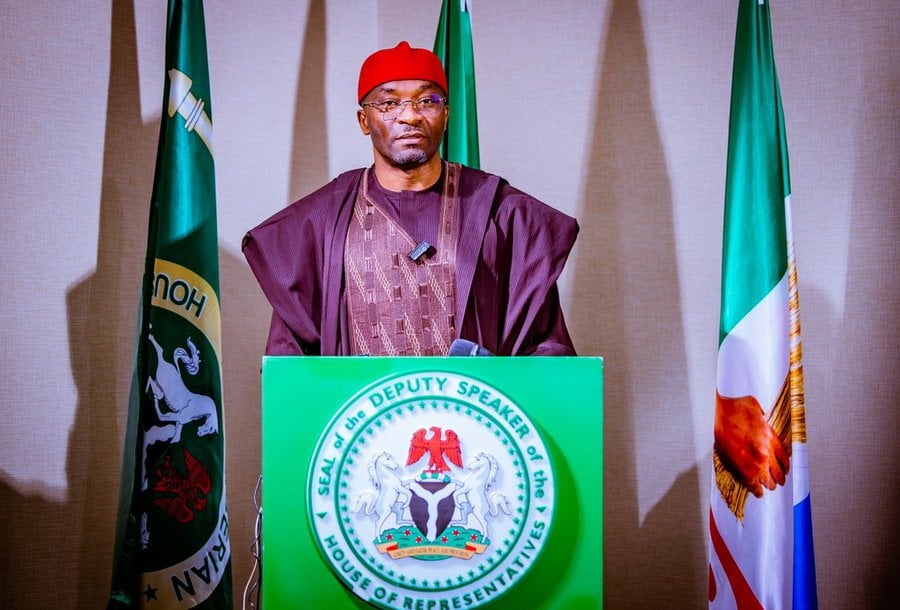
ABUJA (PRECISE POST) – Deputy Speaker of the House of Representatives, Benjamin Okezie Kalu, has urged Igbo elders, political leaders and other stakeholders to unite and speak with one voice to strengthen the South-East’s political influence and relevance in Nigeria.
Kalu also called on the people of the region to abandon the mindset of staying away from national politics, stressing that active participation in the country’s political and governance processes was essential to securing their interests.
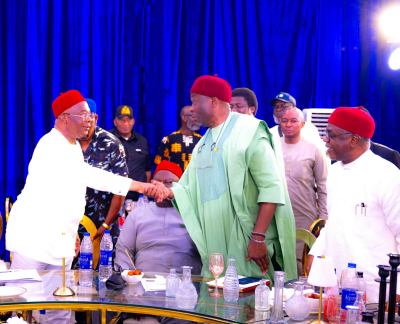
The Deputy Speaker made the appeal on Friday at the South-East Stakeholders’ Convergence (SESC), also known as the South-East Elders and Stakeholders Meeting, held at the Imo State Government House, Owerri.
The meeting, convened to deliberate on unity, progress and peace in Igbo land, was chaired by former Military Governor of Imo State and former Minister of Foreign Affairs, Senator Ike Nwachukwu (rtd.).
Addressing the gathering, Kalu, who represents Bende Federal Constituency of Abia State, described unity as the foundation of development, insisting that peace and progress in Igbo communities could only be achieved when leaders worked together in harmony.
“Unity is strength. We will achieve more when we are united. The need for unity cannot be overemphasized. Peace leads to the development of communities,” he said.
He commended the elders and stakeholders for setting aside their personal engagements to deliberate on the future of the South-East, describing their participation as a demonstration of patriotism and commitment to the development of Igbo land.
Kalu said the example set by the elders would inspire younger generations to embrace collective leadership and sustain the struggle for the region’s progress.
He likened leadership to a relay race, in which older generations must hand over the baton to younger ones to continue the journey of development.
“Some of us who are coming up are encouraged by this unity and patriotism you display. We are glad to see our elders sit together to discuss the future of Igbo land. This is like a relay race, where you run and later hand over the baton to the next person and the next generation,” he said.
The Deputy Speaker, however, warned that the absence of unity among the Igbo could undermine their collective identity, political strength and cultural heritage.
He expressed concern that despite being one of Nigeria’s major ethnic groups, the South-East had yet to fully translate its population and political potential into commensurate influence at the national level.
According to him, the dispersion of Igbo people across different parts of the country has also affected the region’s ability to consolidate its voting strength across the five South-East states.
Kalu argued that a common political agenda, backed by collective action, would enable the Igbo to exert greater influence in national affairs and command more respect across the country.
He cautioned against the tendency of individuals and groups to pursue separate interests, saying such an approach weakens the region’s collective bargaining power and diminishes its political relevance.
The Deputy Speaker further attributed the region’s limited political engagement, in part, to a post-civil war mindset that encouraged many Igbo people to concentrate on individual and economic advancement while distancing themselves from Nigeria’s political affairs.
Heurged the people to abandon the attitude, insisting that political participation and involvement in governance should be treated as a collective responsibility.
“After the war, we had believed we will work it out on our own and develop our place. We say we are not interested in politics. It is not our business. We have tried to develop on our own. It is about time we changed that mindset,” he said.
Kalu stressed that the South-East could not afford to remain outside the country’s decision-making process, warning that those who were absent from the negotiating table would have little influence over decisions affecting their future.
“There is no wisdom in saying we are not interested in the politics of Nigeria. It should be our business. Let us say one thing and stick to it with one mind, then, we will see the result of our togetherness,” he added.
The convergence attracted Imo State Governor, Hope Uzodimma, as chief host, alongside traditional rulers, representatives of religious organisations, women and youth groups from the five South-East states, as well as prominent Igbo figures from politics, business, academia and public administration.
Precise Post recalls that among those in attendance were former Senate President and Secretary to the Government of the Federation, Senator Anyim Pius Anyim; immediate past Vice-Chancellor of the Federal University of Technology, Owerri, Prof. Nnenna Oti; former Chairman of the Police Service Commission, Chief Simeon Okeke; former President-General of Ohanaeze Ndigbo, Nze Ozichukwu Chukwu; Chief Tony Chukwu; Ambassador Greg Mbadiwe; Prof. Osita Ogbu; Mazi Sam Ohuabunwa; and Ambassador Okey Emuche.