By Our Reporter
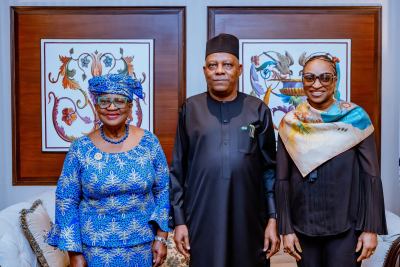
Vice President Kashim Shettima has reaffirmed Nigeria’s commitment to the World Trade Organisation (WTO) and the multilateral trading system, declaring that no country can achieve sustainable prosperity in isolation from the global community.
Shettima said Nigeria would continue to support the WTO in strengthening multilateralism and promoting a global system founded on cooperation rather than isolation.
The Vice President stated this on Saturday during a meeting with the Director-General of the WTO, Dr Ngozi Okonjo-Iweala, on the sidelines of the ongoing BRICS Leaders’ Summit in New Delhi, India.
According to a statement signed by Stanley Nkwocha, Senior Special Assistant to the President on Media & Communications, Office of the Vice President, Shettima stressed the interconnectedness of nations and the importance of global cooperation.
“I believe the world is greater than one nation. We will continue to support the WTO in championing the cause of multilateralism. We are essentially one human family and interconnected. You cannot divorce yourself from the global community,” he said.
Shettima also described migration as an important driver of development, innovation and economic growth, noting that immigrants had historically played significant roles in the development of nations and cities across the world.
“Nations are built by immigrants. Even cities are built by people who came from outside, not just by the locals. That goes to show that we have so much to gain from global migration,” he said.
The Vice President cited the Nigerian diaspora as an example, noting that Nigerians living abroad had continued to distinguish themselves through educational attainment, entrepreneurship and professional accomplishments.
He referenced a recent Pew Research Center analysis of 2024 US Census Bureau data, which showed that 67 per cent of Nigerian-born Black immigrants aged 25 and above in the United States held at least a bachelor’s degree.
Shettima said the figure represented the highest proportion among the major Black immigrant groups examined.
The Vice President also commended Okonjo-Iweala for her leadership of the WTO, urging her to continue deploying her experience and expertise to advance global development.
“You are doing a very wonderful job at the WTO, but you still have a lot to contribute to humanity,” he told the WTO Director-General.
Okonjo-Iweala, who became the first woman and first African to lead the WTO, began her second four-year term as Director-General in September 2025.
Meanwhile, Shettima is expected on Sunday to present Nigeria’s partnership and foreign investment opportunities to leaders of the BRICS alliance at the ongoing summit, themed “Building for Resilience, Innovation, Cooperation and Sustainability.”
The Vice President is also expected to highlight the Federal Government’s efforts to promote a more inclusive international order while reiterating President Bola Tinubu’s Renewed Hope Agenda, particularly its focus on creating sustainable opportunities through economic reforms, infrastructure expansion and private-sector-led growth.
Tag:
Ngozi okonjo-iweala
ABUJA – The Director-General of World Trade Organisation (WTO), Dr Ngozi Okonjo-Iweala, says in spite of certain policy uncertainties, 72 per cent of world trade still goes on under the Organisation.
Okonjo-Iweala said this in Abuja at the ongoing 7th Africa Emerging Markets Forum.
The forum was jointly organised by the Central Bank of Nigeria (CBN), Emerging Markets Forum (EMF) and the Centre for the Study of Economies of Africa (CSEA).
According to Okonjo-Iweala, in modern terms, world merchandise trade grew by 4.6 per cent as surging demand for AI-related goods offset weaknesses linked to tariff increases trade policy uncertainty.
“Services trade grew by 5.3 per cent again in modern terms, and within that, trading digitally delivered services grew even faster, at almost six per cent.
“Most countries continue to trade on rules-based WTO terms. Around 72 per cent of global goods trade continues to flow on core WTO-most-favoured-nationtariffs,” she said.
“Additional 16 per cent goes on terms within the wider WTO framework, mostly tariff preferences arising from bilateral and regional trade agreements that are built on WTO foundations,” she said.
She said that global goods trade volumes in 2025 were over 12 per cent higher than in 2019, the year before the COVID-19 pandemic, while services trade volumes were 31 per cent higher.
According to her, countries are responding to the Strait of Hormuz crisis with more trade facilitating than trade-restrictive measures.
“They are lifting trade restrictions, facilitating trade in oil and gas products, finding alternative routes to get oil and fertiliser out of the region.
“These measures have not been enough to compensate for the closure of the strait which has hit the world, and especially vulnerable African countries with higher energy, fertiliser and food prices.
“They have not built resilience and prevented a situation that could have been considerably worse for the global economy.
“On the whole, while active strategic competition is affecting some sensitive products and bilateral relationships, the repeal practise of most countries seems to be for continued interdependence, albeit within concentric circles of relatively closer or looser integration.”
She said that the Global South offered a case in point, adding that the share of South-South trade in the global total had increased from under one-tenth in 1995 to about a quarter today.
“They are keeping their trade diplomats busy. Of the 384 existing regional trade agreements that have been formally notified to the WTO, 49 per cent are among developing countries.
“Among the eight additional agreements that have not been notified, the South-South share appears to be even higher, and 22 economies still outside the 166 from the WTO are working hard to accede to it,” she said.(NAN)
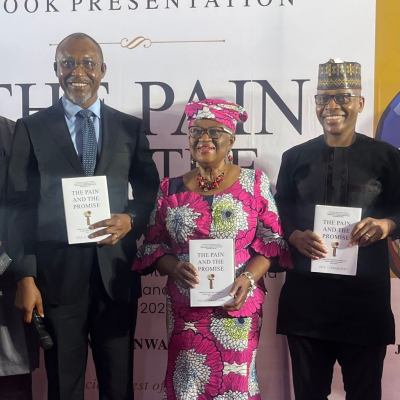
At Paul Nwabuikwu’s book presentation yesterday, I shared a story publicly for the first time about how Dr. Ngozi Okonjo-Iweala stopped me from “japa.”
Aunty Ngoo, as I have always called her, was Minister of Finance when I served as Corps Marshal of the FRSC. Despite the country’s fiscal constraints, she was always willing to support the FRSC whenever we had genuine funding needs.
When I joined the Federal Executive Council, she became something of a guardian angel to the younger members of the Council. Dr. Nurudeen Mohammed and I benefited immensely from her wisdom and generosity. She was, and remains, a natural mentor.
The 2019 elections took a great deal out of me. I played a key role in reconciling President Olusegun Obasanjo and his erstwhile Vice President, Atiku Abubakar. I later managed the Atiku/Obi campaign Situation Room and served as the PDP’s principal witness at the Presidential Election Tribunal.
When it was all over, I was exhausted and deeply saddened by the outcome.
I travelled to the United States, where my wife had begun her PhD programme. My plan was to shuttle between Nigeria and the US while I figured out the next phase of my life.
Then, in early 2020, a judicial pronouncement on a governorship election left me completely disillusioned.
After leaving office as Minister of Aviation, I had turned down a number of international opportunities because I had resolved to build a political career in Nigeria. But after that setback, I felt I had reached the end of the road.
I went to see Aunty Ngoo in her office at Gavi, on Pennsylvania Avenue in Washington, DC. I told her I was now ready to accept an international role or perhaps return to ExxonMobil, where I had been granted an extended leave of absence when I became Corps Marshal and where the door remained open.
She listened quietly.
Then she said something I have never forgotten:
“Osita, Nigeria needs people like you. Do not allow life’s inevitable setbacks to define your choices. Go back to Nigeria. Stay in the trenches. Don’t give up.”
It was not the advice I wanted to hear. But it was exactly the advice I needed.
I left her office, reflected deeply on our conversation, and returned to Abuja.
Today, when I look at what has emerged since then, the Athena Centre, Mekaria Institute, ClearPath Media, my law degree, and the many opportunities to continue serving our country, I often think back to that conversation.
One conversation changed the trajectory of my life.
Thank you, Aunty Ngoo.
Osita Chidoka
29 July 2026
Okonjo-Iweala, others urge youths to drive reforms, strengthen civic action
written by Content Admin

Some dignitaries during the relaunch of Footprints: Past, Present, Future (2nd Edition) in honour of late Dr Christopher Kolade.
LAGOS- National leaders have challenged youths to lead Nigeria’s renewal, warning that meaningful change now depends on young citizens organising, demanding accountability and driving sustained civic action.
They made the call on Wednesday night at the 15th anniversary of Enough is Enough Nigeria (EiE), held in Lagos, with the theme “Footprints and Frontlines”.
The News Agency of Nigeria (NAN) reports that EiE is a civil society organisation advocating for accountable governance and citizen participation.
In a virtual keynote address, Director-General of the World Trade Organisation (WTO), Dr Ngozi Okonjo-Iweala, urged young Nigerians to lead change with courage and conviction.
She recalled her 2010 message to youths, saying it remained relevant.
“Do not wait and watch. Do not ask for permission. Get up, organise and make a difference,” she said.
Okonjo-Iweala noted that with 70 per cent of Nigeria’s population under 30, young people hold huge influence in shaping the country’s direction.
She urged them to use their numbers constructively while confronting persistent challenges such as unemployment and poor access to capital.
She praised EiE’s “Office of the Citizen” initiative for empowering communities to demand transparency and improved public services, adding that civic pressure was crucial for reform.
“Real change depends on organised, determined and courageous young citizens,” she said.
In his remarks, Emir of Kano and former Central Bank Governor, Mohammad Sanusi, said rebuilding Nigeria required honesty and collective responsibility.
“As citizens, we must remember this nation belongs to us. We have done enough damage. Enough is enough, we need to stop,”he said.
Sanusi said Nigeria had repeatedly missed development opportunities because public office was often treated as personal property.
He called for a shared national vision that transcends ethnicity, religion and political interest.
Bishop Matthew Kukah of the Catholic Diocese of Sokoto commended EiE for its resilience in advancing social justice and called on Nigerians, especially the youth, to persist in the struggle for a fair society.
“The journey to justice and fairness has no finish line.
Let us remain relentless in building a Nigeria that is just, equitable and bigger than all of us,” Kukah added.
Former Minister of Communication Technology, Mrs Omobola Johnson, emphasised collaborative effort in nation-building, saying development required hard work, sacrifice and citizens’ willingness to contribute their “time, talents and treasures.”
Executive Director of EiE, Yemi Adamolekun, said Nigeria continued to underperform because citizens were not demanding enough from leaders.
She urged Nigerians not to detach their personal progress from the fate of the country.
She said, “Whatever industry we work in, if Nigeria becomes a failed state, we will all suffer. Silence is not an option. Evil is amplified when good people stay silent.”
After highlighting EiE’s milestones over the past 15 years, Adamolekun announced 36-year-old Mrs Ufuoma Nnamdi-Udeh as the organisation’s new Executive Director.
The anniversary also featured the relaunch of Footprints: Past, Present, Future (2nd Edition), compiled by EiE and forwarded by the late diplomat Dr Christopher Kolade, in whose honour the event was partly dedicated.
Attendees also watched the premiere of One Voice, Many Echoes, a short film featuring archival footage from the 1993 election annulment protests, the 2010 Enough is Enough marches and the 2020 EndSARS demonstrations. (NAN)
Reforms: Okonjo-Iweala’s commendation validates Tinubu’s progressive leadership — Support group
written by Administrator
LAGOS – The Tinubu Media Force (TMF), a support group for President Bola Tinubu, says Dr Ngozi Okonjo-Iweala’s recent remarks on Nigeria’s economic trajectory is a clear and independent validation of Tinubu’s progressive governance.
The TMF National Coordinator, Mr Oluwagbenga Abiola, said this in a statement on Friday in Lagos.
Abiola was reacting to Okonjo-Iweala, ‘s commendation of the President’s economic policies.
Okonjo-Iweala, Director-General of World Trade Organisation(WTO), on Thursday commended Tinubu for working to stabilise the economy, saying his administration’s reforms are moving in the right direction.
Okonjo-Iweala, a globally respected economist and a former Minister of Finance, spoke to State House correspondents after a courtesy visit to the President on Thursday in Abuja.
He said: “For the Tinubu Media Force, this endorsement is further proof that the administration’s reforms are laying the right foundations for sustainable growth.
“Economic data support this view. Nigeria’s GDP grew by 3.13 per cent in the first quarter of 2025, with the services sector surging by over 5 per cent.
“The Tinubu administration is targeting 7 per cent annual growth by 2027 and a quadrupling of the economy by 2030, anchored on a rebased GDP of N372.8 trillion. Key reforms span energy, transport, education, agriculture, and industry.”
Noting that education remains a flagship priority for Tinubu’s administration, Abiola said that the Nigerian Education Loan Fund (NELFUND) had disbursed over N104 billion to no fewer than 600,000 students in federal tertiary institutions.
According to him, this includes N20.07 billion in tuition payments to 192,906 students and N12.82 billion in stipends to 169,114 students.
“With over 9,000 applications processed daily, the scheme has been described as a lifeline for Nigerian families,” he said.
On infrastructure, Abiola said that the administration was driving landmark projects such as the 700km Lagos-Calabar Coastal Highway, projected at $11 billion to connect nine states and create millions of jobs.
“Work on the first 47.47km segment is underway, backed by $747 million in funding,” he said.
Abiola said that other major road projects include the 1,000km Sokoto-Badagry Superhighway, dualisation of the Kano–Maiduguri Road, rehabilitation of the Enugu-Port Harcourt Expressway, completion of the Abuja-Kaduna-Zaria-Kano Road, and reconstruction of over 330 roads and bridges across the country.
According to him, beyond roads, the government has launched construction of 10,000 affordable housing units, expanded the national health insurance scheme to include children, improved passport processing, and stabilised electricity supply across board.
He said that the government has also commissioned new federal medical centres for affordable access to health care .
“Agricultural reforms and the introduction of compressed natural gas (CNG) as an affordable transport fuel are also expected to reduce food and transportation costs,” he said.
According to him, the proposed tax reform bill also aims to ease burdens on low and middle income earners by eliminating regressive levies, simplifying tax collection, and focusing more on high income sectors and large corporations.
Commending Okonjo-Iweala for her “objective and fact-based” analysis, Abiola urged commentators to evaluate the administration’s performance on measurable achievements rather than partisan narratives. (NAN)
ABUJA – Dr Ngozi Okonjo-Iweala, the Director-General of the World Trade Organization, (WTO,), says President Bola Tinubu deserves credit for stabilising Nigeria’s economy through bold reforms.
She spoke with State House correspondents on Thursday after a closed-door meeting with the President at the Presidential Villa, Abuja.
Okonjo-Iweala noted the government’s efforts to steady the economy as a key step in building long-term growth.
”The president and his team have worked hard to stabilize the economy and you can’t really improve an economy unless it’s stable.
“He has to be given the credit for the stability of the economy, so the reforms have been in the right direction,”
She emphasised that stabilising the economy is only the beginning of a broader recovery agenda.
The WTO boss however stressed that more work is needed to stimulate inclusive growth and alleviate poverty in the country.
“What is needed next is growth. We now need to grow the economy and we need to put in social safety nets so that the people who are feeling the pinch of the reforms can also have some support to be able to weather the hardship.
“That’s the next step, how do we build social safety nets to help Nigerians cushion the hardship they are feeling and how do we grow the economy so we can create more jobs and put money in people’s pockets? These are issues we discussed with the President.”
She stressed the need for policies that directly impact the lives of Nigerians and create economic opportunities.
Okonjo-Iweala assured of the WTO’s continued support for Nigeria’s economic revival.
The meeting signals continued collaboration between the Tinubu-led government and international partners to drive economic recovery.
Reports that the World Bank acknowledges that Nigeria’s economy is stabilising under President Tinubu’s administration, with projected growth of 3.6 per cent in 2025.
This positive outlook is attributed to macroeconomic reforms, particularly in the petroleum, foreign exchange, and power sectors, which are creating a more stable business environment.
While inflation remains a challenge, the World Bank noted that the reforms were yielding positive results, including a significant increase in national revenue and a reduction in the fiscal deficit. (NAN)
PRECISE – Global trade is expected to plummet this year in the wake of President Donald Trump’s tariff offensive, fuelling uncertainty that threatens “severe negative consequences” for the world, the World Trade Organization warned Wednesday.
Since returning to office, Trump has imposed a 10 percent tariff on imports of goods from around the world along with 25 percent levies on steel, aluminium and cars.
While Trump made a U-turn on steeper tariffs for dozens of countries, he has escalated a trade war with China, slapping 145 percent levies on Chinese goods while Beijing retaliated with a 125 percent duty on US products.
“I’m very concerned,” WTO chief Ngozi Okonjo-Iweala told reporters, adding that the organisation expected to see trade volumes between the United States and China crumble by a whopping 81 percent.
“The enduring uncertainty threatens to act as a brake on global growth, with severe negative consequences for the world, the most vulnerable economies in particular,” she warned in a statement.

At the start of the year, WTO expected to see global trade expand in 2025 and 2026, with merchandise trade seen growing in line with global GDP, and trade in services growing even faster.
But in the organisation’s annual global trade outlook published Wednesday, it determined that as things stand, world merchandise trade is on course to fall 0.2 percent this year, “before posting a modest recovery of 2.5 percent in 2026”.
The 2025 number, calculated in line with the tariff situation on April 14, is already nearly three percentage points lower than what would have been expected without the tariffs Trump has slapped on countries around the globe.
– ‘Severe downside risk’ –
The WTO warned that “severe downside risks” could see trade “shrink even further, to 1.5 percent in 2025, if the situation deteriorates”.
The WTO also cautioned that services trade, while not directly subject to tariffs, was also “expected to be adversely affected”.
The global volume of commercial services trade was now forecast to grow by 4.0 percent — around a percentage point less than expected.
This year, the impact of the tariffs was expected to be felt quite differently in different regions, the WTO said.
“Under the current policy landscape, North America is expected to see a 12.6-percent decline in exports and 9.6-percent drop in imports in 2025,” the organisation said.
“The region’s performance would subtract 1.7 percentage points from world merchandise trade growth in 2025, turning the overall figure negative,” it pointed out.
Asia was projected to post “modest growth”, with both exports and imports set to swell by 1.6 percent.
Chinese merchandise exports in particular were forecast to rise by between four and nine percent across all regions except North America, “as trade is redirected”, WTO said.
And European exports were on track to grow by one percent, and imports by 1.9 percent.
– ‘Decoupling’ –
The WTO said its economists expect global gross domestic product (GDP) to grow 2.2 percent this year, and 2.4 percent in 2026.
The organisation said it expected tit-for-tat tariffs to have only a “limited” direct impact on that figure.
But Okonjo-Iweala told reporters the “sharp projected decline in US-China bilateral trade” risked more “far-reaching consequences”.
While US-China trade accounts for just around three percent of world merchandise trade, she warned that what appears to be the ongoing “decoupling of the two economies” could lead to “a broader fragmentation of the global economy along geopolitical lines into two isolated blocks”.
In that scenario, “our estimates suggest that global … GDP would be lowered by nearly seven percent in the long term”, by 2040, she said.
“This is quite significant and substantial.”
Faced with this crisis, Okonjo-Iweala called for reform, urging countries to “inject dynamism” into the WTO.
In particular, she called for the organisation, which only acts through consensus — a painstakingly slow process –, to “streamline decision-making, and adapt our agreements to better meet today’s global realities”.
“We shouldn’t waste this crisis.”
AFP
US President Donald Trump’s worldwide tariff salvo could lead to an overall contraction of around 1 percent in global merchandise trade volumes this year, the WTO chief warned Thursday.
After Trump on Wednesday unveiled a blitz of harsher-than-expected levies aimed at countries around the globe, Ngozi Okonjo-Iweala warned the measures would “have substantial implications for global trade and economic growth prospects”.
Trump slapped 10 percent import duties on all nations and far higher levies on imports from dozens of specific countries — including top trade partners China and the European Union — adding to tariffs already imposed since his return to power in January.
“While the situation is rapidly evolving, our initial estimates suggest that these measures, coupled with those introduced since the beginning of the year, could lead to an overall contraction of around 1 percent in global merchandise trade volumes this year,” the World Trade Organization director-general said in a statement.
This, she said, would represent a drop of nearly four percentage points from the WTO’s previous projection.
Okonjo-Iweala urged WTO members to manage the tensions resulting the US measures responsibly.
“I’m deeply concerned about this decline and the potential for escalation into a tariff war with a cycle of retaliatory measures that lead to further declines in trade.”
Okonjo-Iweala stressed that despite the US measures “the vast majority of global trade” still flows under WTO’s so-called Most-favoured-nation (MFN) status, which bars countries from discriminating between their trading partners.
“Our estimates now indicate that this share currently stands at 74 percent, down from around 80 percent at the beginning of the year,” she said.
“WTO members must stand together to safeguard these gains.”
Okonjo-Iweala highlighted the fact that “the WTO was established to serve precisely in moments like this — as a platform for dialogue, to prevent trade conflicts from escalating, and to support an open and predictable trading environment”.
AFP
Tinubu congratulates Okonjo-Iweala, others on UNILAG’s honorary doctorate awards
written by Content Admin
ABUJA- President Bola Tinubu has congratulated Dr Ngozi Okonjo-Iweala, DG, World Trade Organisation; Mr Fola Adeola, co-founder of GTBank Plc; and Mr Kola Adesina, MD, Sahara Power Group, on the honorary doctorate degrees conferred on them by the University of Lagos (UNILAG).
The University recognised Okonjo-Iweala as the first African woman to lead the World Trade Organisation and for introducing significant reforms in Nigeria’s financial sector, Mr Bayo Onanuga, the President’s spokesman, said in a statement on Thursday.
The university honoured Adeola for his pioneering role in the Nigerian banking sector and for founding the FATE Foundation, an NGO mentoring young Nigerian entrepreneurs through training and loans.
Adesina, an alumnus of the University, was recognised for his innovative contributions to the energy industry.
Adesina is the Group Managing Director (GMD) of Sahara Power Group, an energy and infrastructure organisation with operations in 42 countries.
“The three distinguished Nigerians were awarded a Doctor of Science honorary degree (D. Sc) by the University at its 55th convocation on January 16.
“President Tinubu deeply admires these exceptional Nigerians who have excelled in their careers and are role models for the nation’s youth.
“In one of the congratulatory letters, President Tinubu praised Mr Adesina for his significant contributions to Nigeria’s energy sector, highlighting this recognition as a reflection of his commitment to advancing national development,” Onanuga said in the statement.
The President also stated that the three Nigerian icons deserved recognition for their pursuit of excellence, hard work, and invaluable contributions to the nation’s economic development.
“I encourage you to continue to serve as beacons of hope, innovation, and inspiration for future generations. Please know that your contributions remain deeply valued by the government and people of Nigeria,” Tinubu said. (NAN)
ABUJA- President Bola Tinubu on Friday congratulated Dr Ngozi Okonjo-Iweala, former Coordinating Minister for the Economy and Minister of Finance, on her unanimous re-election today as the Director-General of the World Trade Organisation (WTO).
Okonjo-Iweala made history in 2021 as the first African and first woman to lead the 164-nation-member WTO.
Her first term as the seventh director-general of the WTO will expire on Aug. 31, 2025, while the second term begins Sept.1, 2025, Mr Bayo Onanuga, Special Adviser to the President, Information and Strategy, said in a statement.
Tinubu said Okonjo-Iweala’s unanimous appointment for a second four-year term demonstrated the trust and confidence the international community placed in her leadership to advance multilateral trade for sustainable global development.
“President Tinubu is confident that her continued leadership will strengthen the international economic organisation’s role as a critical pillar of inclusive global economic growth and good governance in the next four years.
“As a committed member of the WTO, ECOWAS, and the African Continental Free Trade Area (AfCFTA), Nigeria will continue to support the WTO’s mission to foster a fair, inclusive, and equitable multilateral trading system.
“President Tinubu assures Okonjo-Iweala of Nigeria’s steadfast support as she consolidates her bold reforms, dedication to equitable global trade practices, and tireless efforts to promote international cooperation,” Onanuga said. (NAN)