
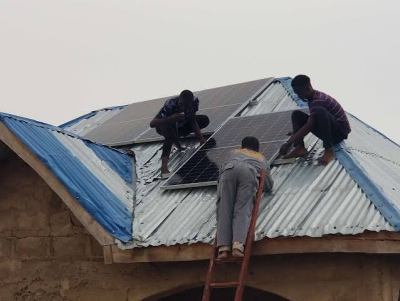
The Federal Government has shelved plans to immediately ban the importation of solar panels, following strong opposition from business leaders and renewable energy advocates.
The Minister of Innovation, Science and Technology, Kingsley Udeh, announced the decision on Friday, saying an immediate ban would increase electricity costs and slow Nigeria’s clean energy transition before local manufacturers can meet national demand.
Udeh said government will instead focus on ensuring that only standard, quality solar panels – whether locally manufactured or imported from reliable sources – are sold in the Nigerian market.
“Covering the energy gap in Nigeria. Part of what we are doing is referred to as renewed hope solarisation project where we are taking off federal universities, institutions, special academic institutions, giving them access to electricity. We can’t ban solar panel importation if we can’t produce locally,” the Minister told the Nigerian Television Authority, NTA.
“Soon you will see that we only have in the Nigerian market standard solar panels, either manufactured in Nigeria or imported from reliable sources, and they’re all high standard.”
Nigeria currently depends heavily on imported solar equipment to power homes and businesses amid unreliable grid supply and millions still without electricity.
Data from Chinese customs cited by energy think tank Ember showed that China exported 2.4 gigawatts of solar panels to Nigeria in the 12 months to August 2026, valued at $269 million.
Analysts say generating the same amount of electricity with diesel generators could cost about $980 million annually, meaning Nigerians could save over $700 million a year if solar fully displaces diesel.
A 420-watt solar panel costing about $60 can generate approximately 550 kilowatt-hours of electricity annually. Generating the same with diesel could cost about $160 a year. Under that comparison, the cost of the panel could be recovered in roughly five months, excluding batteries, inverters and installation.
Reacting, President of the Renewable Energy Association of Nigeria, Ayo Ademilua, said local factories are not yet equipped to meet demand in volume and price.
“Our members share the Minister’s dream of a Nigeria that makes its own solar panels. But we have to be honest about where we are. Solar has become a lifeline for millions. A ban now would have raised costs, stalled projects and put the progress of the last decade at risk,” Ademilua said.
Also speaking, Executive Director of the Global Initiative for Food Security and Ecosystem Preservation, Dr David Michael, said Nigeria should not have to choose between building a domestic solar industry and making clean energy affordable.
Stakeholders are now calling for a phased transition of three to five years, with clear timelines and incentives for local manufacturers.
The debate dates back to March 2025 when former Minister Uche Nnaji proposed restricting imports to encourage local production.

