
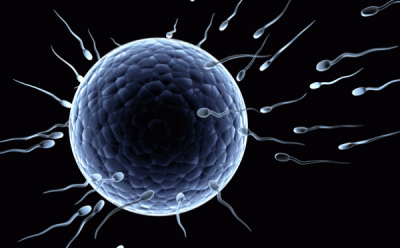
A new study has found that sperm quality declines during prolonged sexual abstinence due to extended storage in the body.
The study, published in Proceedings of the Royal Society B on Monday, analysed semen data from 115 studies involving nearly 55,000 men, as well as 56 studies across 30 animal species, including birds, bees, reptiles, and other mammals, to assess the impact of sperm storage.
The findings showed that prolonged abstinence reduced sperm health, with declines in motility (ability to swim) and viability (how many are alive), and increased DNA damage.
In animals, the study found that embryos produced from stored sperm — whether kept in males before ejaculation or in females before fertilisation — had lower survival rates.
Researchers noted that the decline in quality may stem from biological changes in stored sperm compared to newly produced ones.
They also found that while sperm quality deteriorates in females after mating, the process occurs more slowly than in males, thanks to protective substances within the female reproductive tract that aid sperm preservation.
In humans, sperm can survive inside the female body for several days. In contrast, species such as queen ants, bees, and female bats are capable of storing sperm for months or even years before fertilisation.
The study’s authors suggested the findings could carry implications for infertility treatment, indicating that using freshly ejaculated sperm may lead to better fertility outcomes.
While the World Health Organization currently recommends abstaining from ejaculation for two to seven days prior to providing a sperm sample for analysis or procedures like IVF, the study proposes that shorter abstinence periods may be more beneficial for optimising sperm quality.
Lead author Krish Sanghvi advised that prolonged abstinence may not always be advantageous, emphasising that sperm quality — not just quantity — plays a critical role in fertilisation success.
“All we recommend is that clinicians and couples reconsider whether long abstinence is always good, because abstinence leads to deterioration in sperm quality,” Sanghvi said.
“If sperm quantity is the only thing that matters for a clinic or couple, then sexual abstinence is not necessarily a bad thing. But usually fertilisation success will be determined not only by how many sperm there are but the quality of the sperm too, for example, in IVF.”

