
By Chibuike Nwabuko
ABUJA (PRECISE POST) – President Bola Tinubu has described Nigeria’s youthful population as the country’s greatest asset, assuring foreign investors that the nation’s tech-savvy and adaptable workforce is well-positioned to compete in the global digital economy.
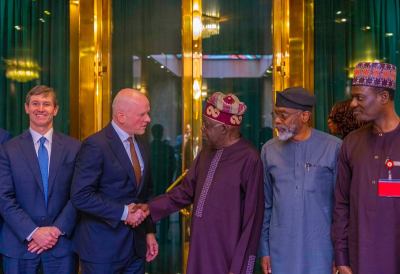
The President gave the assurance on Tuesday while receiving a delegation of Mastercard, led by its Global Chief Executive Officer, Michael Miebach, at the Presidential Villa in Abuja.
According to the statement signed by Bayo Onanuga, Special Adviser to the President on Information and Strategy, Tinubu welcomed Mastercard’s proposal to train five million Nigerian businesses and equip them with digital skills, saying the initiative aligns with his administration’s efforts to reposition and stabilize the economy while empowering young people and small businesses through technology.
According to the President, the ongoing formalisation of Nigeria’s largely informal business sector will unlock new opportunities for digital transformation, investment, job creation and economic growth.
“I am glad that you are very familiar with the terrain. I can classify you as a Nigerian. Mastercard has a very big reputation in financial management, and opportunities are spreading in Nigeria,” Tinubu said.
He noted that more small businesses are embracing technology and registering formally, a trend he said would strengthen the economy and promote financial inclusion.
Emphasising the importance of youth empowerment, Tinubu said his administration remains committed to equipping young Nigerians with digital skills needed to address present and future challenges.
“The most important asset is our youth,” the President stated, adding that payment platforms and financial inclusion mechanisms are essential for the growth of Micro, Small and Medium Enterprises (MSMEs).
He commended Mastercard’s engagement with Nigeria’s youth population and pledged continued government support for the company’s initiatives.
Speaking during the meeting, Minister of Finance and Coordinating Minister of the Economy, Taiwo Oyedele, said ongoing economic reforms have created significant opportunities in payment systems, digital services and the credit economy.
Oyedele noted that government efforts to digitise public services and formalise businesses are yielding results, revealing that more than 10,000 informal businesses have been applying for registration daily in recent months.
He said the administration’s reforms are also expanding opportunities in mortgages, consumer credit, student loans, auto financing and small-business lending.
The minister added that Nigeria remains a major hub for financial technology innovation, with five of Africa’s nine fintech unicorns operating in the country.
In his remarks, Mastercard CEO Michael Miebach reaffirmed the company’s commitment to supporting Nigeria’s economic transformation agenda.
Miebach, who said he personally established Mastercard’s Nigerian operations in 2011, described the country as a key growth market with enormous potential.
“We have seen the country grow and lead. There is a lot of momentum in Nigeria,” he said.
According to him, Mastercard currently helps prevent about $200 million in fraud annually and contributes roughly $2 billion in foreign exchange inflows into the Nigerian economy.
He disclosed that the company is working to unlock opportunities for Nigeria’s estimated 40 million small and medium-sized enterprises, strengthen connections between the diaspora and the domestic economy, and deepen intra-African digital trade.
Miebach further revealed that Mastercard has developed a framework to empower 40 million small businesses in Nigeria with digital capabilities, including cybersecurity awareness and e-commerce skills.
He announced plans for a three-year programme aimed at building the capacity of small businesses, stressing that the initiative would move beyond discussions to tangible action and measurable impact.
The Mastercard chief also highlighted the company’s investments in digital inclusion, cybersecurity and resilience, including the establishment of a Cyber Centre of Excellence focused on threat intelligence, incident response, artificial intelligence risks and emerging cyber threats.
The meeting underscored growing collaboration between the Nigerian government and global financial technology firms as the country pursues digital transformation, financial inclusion and sustainable economic growth.

