
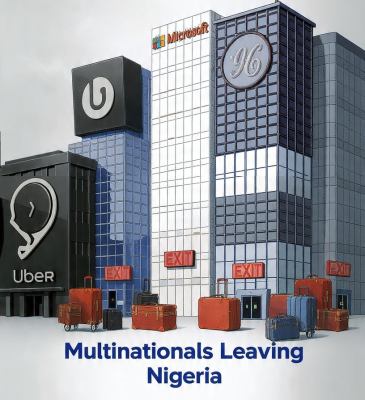
ABUJA – Global e-hailing company, Uber, on Wednesday, September 2, 2026, announced its exit from Nigeria, becoming the latest multinational to wind down operations in the country amid a challenging business environment.
Uber’s departure brings to at least 15 the number of major multinational companies that have either exited, divested, or scaled back operations in Nigeria since 2023, according to data compiled by financial analysts.
Between 2024 alone, at least five significant firms either exited or reduced local production. They include Microsoft Nigeria, TotalEnergies Nigeria, PZ Cussons Nigeria Plc, Kimberly-Clark Nigeria, and Diageo Plc.
Other notable exits and downsizings in the last three years include Unilever Nigeria Plc, Procter & Gamble Nigeria, GlaxoSmithKline Consumer Nigeria Ltd, Shoprite Nigeria, Sanofi-Aventis Nigeria Ltd, Bolt Food, Jumia Food Nigeria, and Equinox Nigeria.
Heineken/Champion Breweries also sold a majority stake to EnjoyCorp, while Pick n Pay sold its 51% stake and exited the retail market. Streaming giant Netflix has equally stopped commissioning Nigerian original productions.
When extended to 2020, the number of firms that have exited or significantly reduced presence in Nigeria approaches 75.
#### *Analysts: ‘Macro Good, Micro Bad’*
Despite improvements in key macroeconomic indicators, analysts say the operating environment remains hostile for businesses.
Nigeria’s Gross Domestic Product grew by 4.43% in real terms in Q2 2026, while inflation moderated to 15.43% in July. The naira has also remained relatively stable post-FX liberalisation, trading at N1,320.56 per dollar as of September 7, 2026.
However, financial expert and Professor of Accounting at Lead City University, Prof. Godwin Oyedokun, said the contradiction between macro stability and micro hardship is driving companies away.
“The continued exit or retrenchment of multinational companies from Nigeria, including Uber, should concern policymakers,” Oyedokun said. “Although it would be wrong to attribute every corporate exit directly to the Tinubu administration. Uber’s decision also reflects its global restructuring and strategic shift.”
He added: “GDP growth, improved foreign reserves and moderating inflation are positive developments, but businesses still face high energy and financing costs, exchange-rate risks, weak consumer purchasing power and regulatory uncertainties. The real test of President Tinubu’s reforms is whether businesses are investing, expanding and creating jobs.”
#### *‘Profits Eroded By Operating Costs’*
Also reacting, the CEO of SD & D Capital Management, Mr. Gbolade Idakolo, said most multinationals were initially attracted by Nigeria’s large population but have seen projected profits eroded.
“The cost of doing business in Nigeria is still very high, with infrastructural gaps yet to be filled, coupled with security challenges,” Idakolo stated. “The projected profits have been eroded by the reduction in the purchasing power of Nigerians, which can be attributed partly to the higher exchange rate and inflation. The businesses also battle with high operating expenses, which are caused by the high cost of energy.”
Idakolo noted that companies that could not withstand the economic realities have exited and moved operations elsewhere, while those still in the country have either downsized or sold part of their business.
#### *What’s Next*
Analysts say the focus must now shift from macroeconomic stabilisation to creating genuine economic competitiveness to retain investors and attract new ones.
The Federal Government is yet to officially react to Uber’s exit and the broader trend of multinational departures.
—
_Reporting for Blueprint Newspapers_
Would you like me to also do a *shorter 200-word version for print* + *SEO headline + meta description* for the website?

