
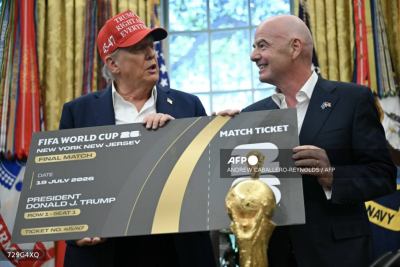
In recent years, the World Cup often rocks around with a few stingers attached to the celebration. A handful of contentious issues that have little to do with the actual football but prove to be just as important as the game itself. There were widespread protests in Brazil over the amount the country’s government was spending to host the 2014 World Cup. The annexation of Crimea from Ukraine and the overall unease that an alleged corruption was involved in the bidding process cast a dark shadow over Vladimir Putin and Russia’s hosting of the 2018 edition. The 2022 World Cup in Qatar received the most universal pushback due to the country’s poor welfare for immigrant workers, human rights records, and anti-LGBT laws. So far, the 2026 World Cup has demonstrated that it’s not deviating from the controversial path of its predecessors; in fact, it might be the most problematic of all.
With the US, Canada and Mexico as co-hosts, the competition is the first World Cup to be hosted by three countries. FIFA’s ambition grew, and the number of participating teams expanded from 32 to 48, increasing the number of games for players already jaded by packed club football schedules. The quality of the football might suffer from players’ fatigue, jet lag, and extreme weather conditions. Aside from on-field issues, the major controversies that will dominate the headlines during the World Cup will be non-football-related.
Here are some of the non-football issues that might dominate discussions at the 2026 World Cup:

The US and Israel’s war on Iran has affected almost every aspect of human life across the globe, and the World Cup will not be exempt from it. This might be the first time a World Cup host or co-host is actively bombing a participating country. The conflict had initially forced Iran to withdraw from the competition, claiming it could not participate in a tournament hosted by one of its attackers. At one point, President Donald Trump warned that it was not “appropriate” for Iranian players to participate in the World Cup “for their own life and safety.”
The threat was real for the Iranian team, in Group G alongside Belgium, Egypt, and New Zealand, is scheduled to play its group matches in the US. The Middle East country only made a U-turn on participating after FIFA moved their training base from the US to Mexico. The team is still expected to travel to the US for their matches.
On Saturday, Iran claimed that some of the team officials had been denied US visas to attend the games. There were also reports that American authorities have ordered the Iranian players to enter and leave the US on the same day of their three group matches.
The hardline immigration policies of Trump’s second term have been one of the most debated topics ahead of the World Cup. Almost 40 percent of participating countries and their travelling fans are facing full or partial visa bans and diplomatic restrictions imposed by the US.
The Trump administration has four participating countries — Iran, Haiti, Senegal and Cote d’Ivoire — on its travel ban and partial restriction list.
On Monday, Omar Artan, the Somali referee selected to officiate at the World Cup, was denied entry to the US. The referee had a valid US visa but was sent back because Somalia is also on the US travel ban list.
The International Sports Press Association (AIPS) earlier complained that “countless” journalists from African and Asian countries have been denied entry visas for the World Cup.
Aside from entry, there is also fear that the Immigration and Customs Enforcement (ICE) operatives might target the World Cup venues to raid and arrest immigrants as part of their widely criticised attempts to rid the US of “illegal aliens”.
MASS SHOOTINGS AND POLITICAL VIOLENCE IN THE US
One of the major security issues in the US in recent years has been mass shootings. According to the Rockefeller Institute of Government, there have been at least 68 mass shootings in the US in the last five years, with hundreds of casualties.
There is also the issue of political violence. Trump has faced three assassination attempts since he assumed office over a year ago, and the country has generally endured an uptick in politically motivated crimes recently.

CARTEL VIOLENCE IN MEXICO
Earlier this year, the perennial drug cartel wars in Mexico worsened. As retaliation for the killing of one of its leaders, the Jalisco New Generation (CJNG) drug cartel engaged in a vicious gun battle with the Mexican military. The cartel placed a bounty on military personnel and police officers. Amid the chaos, several security agencies were killed.
The Mexican authorities have maintained that the country is safe enough to host the World Cup, and over 54,000 security officers have been deployed.
In March, the Football Supporters Europe (FSE) criticised FIFA over ticket prices for big matches at the World Cup. The group described the pricing structure as “extortionate” and a “monumental betrayal”.
The ticket prices for some games at the World Cup are as high as $10,000 — which has led to the competition being dubbed as the most expensive ever. The exorbitant prices have been linked to resale websites.
In July, on FIFA’s own ticket resale site, a handful of tickets were listed at $2 million each.
Gianni Infantino, FIFA president, then defended the astronomical prices, saying he would personally bring a hot dog and a Coke to anyone who buys the $2 million ticket to make sure the individual has a great experience.
While there appears to be no ceiling on ticket prices for important matches, games between lesser-known teams are not selling out as expected for a World Cup.

EXTREME WEATHER CONDITIONS
In July 2025, Enzo Fernández, who won the Club World Cup with Chelsea, described the weather conditions in the US, where the tournament was played, as “very dangerous”.
The Argentine complained of dizziness due to the extreme heat, and Enzo Maresca, a former Chelsea manager, also said it was impossible to hold normal training sessions.
It is in those sweltering conditions that the World Cup will be hosted. To combat the effects of harsh conditions, FIFA has mandated cooling breaks between halves to ensure players are hydrated.
There are also threats of thunderstorms. At last year’s Club World Cup, six matches were halted due to violent lightning and storms. Summer is considered the peak of thunderstorm season in several host cities, and more game stoppages should be expected.

