
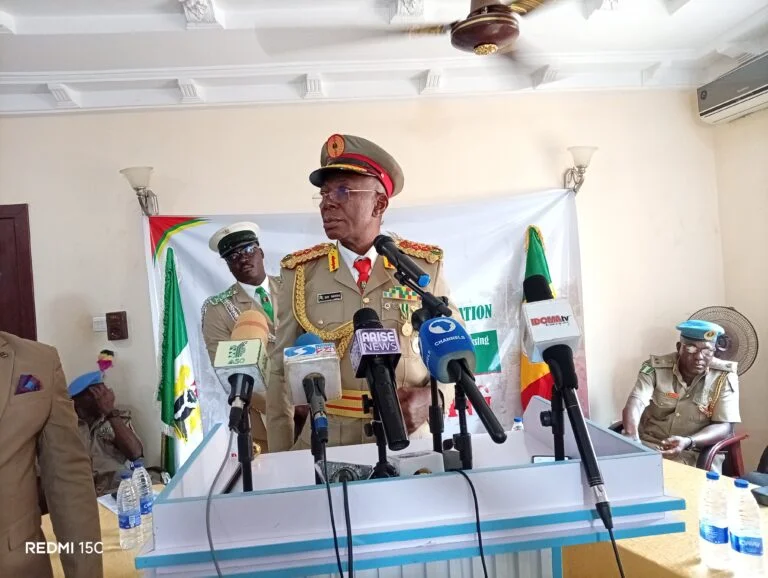
ABUJA – The National Commandant of the Peace Corps of Nigeria, Dr Dickson Akoh, has appealed to the Federal Government to integrate the organisation into ongoing security reforms.
Akoh made the appeal during the Peace Corps’ 28th Anniversary and 2026 Founder’s Day media briefing in Abuja on Friday.
The national commandant, while renewing call for speedy passage of the Peace Corps Establishment Bill, said the organisation’s nationwide network could strengthen grassroots security and enhance national peace-building efforts.
He expressed optimism that the bill’s passage by the National Assembly and presidential assent would become the organisation’s greatest anniversary gift to millions of educated, patriotic and service-oriented Nigerian youths.
He commended officers and members for remaining steadfast in spite of years of institutional and operational challenges.
He urged members of the corps to sustain discipline, resilience and commitment until the organisation received full statutory recognition.

Quoting former U.S. President Franklin Roosevelt, Akoh urged members to embrace patience, ethical conduct and perseverance, insisting these qualities were essential for achieving the Peace Corps’ long-term national mandate.
Addressing journalists after the briefing, Akoh recalled that the organisation started 28 years ago with only 10 members in Kaduna before expanding into a nationwide youth movement.
He said the Peace Corps had more than 187,000 members, operated in about 93 per cent of Nigeria’s local government areas and maintained command offices in all states.
Akoh said the Peace Corps Establishment Bill was passed by the Eighth and Ninth National Assemblies and now awaits final legislative action before presidential assent.
He added that the organisation had gained international recognition, including observer status in the African Union, while establishing offices in New York, Vienna and Sudan to strengthen global partnerships.
Responding to funding questions, Akoh said the Peace Corps remained financially self-sustaining through annual membership dues, camping programmes and other internally generated revenue in spite of lacking statutory government funding.
He explained that prudent management of internally generated resources had enabled the organisation to sustain its programmes, maintain operations nationwide and continue pursuing its objectives.
On unemployment, Akoh said statutory recognition would significantly increase opportunities for engaging more Nigerian youths through structured civic service, leadership development, peace-building initiatives and community-based security programmes.
He maintained that although the Peace Corps currently operates as a non-governmental organisation, it has remained committed to its constitutional objectives in spite of limited resources and operational constraints.
Clarifying its position on security reforms, Akoh stressed that the organisation was not seeking to replace conventional security agencies but to complement them through non-kinetic, community-based interventions.
He disclosed that consultations with the Presidency were ongoing to ensure inclusion in the Federal Government’s evolving security architecture and reform programme.
Enumerating the organisation’s challenges, Akoh identified delays in passing the establishment bill, legal disputes over its national headquarters and worsening economic conditions affecting programme implementation nationwide.
He also cited rising operational costs and insecurity as reasons for scaling down anniversary activities, including cancelling a planned public lecture because of prevailing financial constraints.
Assessing the nation’s security situation, Akoh commended the efforts of the military, police and other security agencies, acknowledging the complexity of Nigeria’s current security environment and emerging threats.
He expressed confidence that the federal government’s ongoing security reforms, supported by the eventual inclusion of the Peace Corps, would significantly enhance national peace, stability and public safety. (NAN)

